




CATEGORIES
- (3)AI & Technology
- (52)Accounting & Financial Reporting
- (1)Accounting for Income Tax
- (1)Assessed losses
- (38)Blogs
- (4)Business Advisory
- (8)Capital Gains Tax
- (1)Capital Gains Tax - Individuals Tax
- (1)Capital Gains Tax Implications of Trusts
- (2)Case study: Home office expense
- (1)Case study: Travel allowances
- (1)Company Formations
- (10)Compliance
- (141)Corporate Tax
- (15)Customs and Excise
- (2)Deceased Estate
- (1)Deductions Pre-trade and prepaid expenses
- (1)Deregistration
- (2)Employer and Employee (PAYE and UIF Specific)
- (1)Estate Duty
- (1)Events / Webinars
- (11)Faculty News
- (2)Farming
- (177)Individuals Tax
- (1)Input - Customs Duty
- (3)Interest
- (23)International Tax
- (1)Nature of the rights of beneficiaries
- (1)Notional input tax
- (10)Payroll
- (1)People & Practice Management
- (2)Practical Payroll
- (1)Professional Ethics
- (2)Provisional tax (Link with other Taxes)
- (4)SARS Issues
- (178)Tax Administration
- (2)Tax Administration Part 2B: Resolving Problems with SARS using the Tax Ombud
- (1)Tax Administration Part 3B Dispute Resolution - Objection and appeal
- (8)Tax Dispute Resolution
- (1)Tax Opinions
- (3)Tax Update
- (1)Tax implications of loans to trusts
- (1)Tax residence
- (1)Tax returns and payments
- (3)Transfer-Pricing
- (1)Trust Income / Gain Allocations
- (1)Trust types and income allocations
- (12)Trusts
- (88)VAT
- (3)VAT periods
- (1)Wear and tear allowances
- (14)Wills, Estates & Succession
- (1)Zero Rated
- (2)eFiling
- Show All

Substantiating business travel by motorcycle
- 28 October 2026
- Individuals Tax
- Dr Stiaan Klue
Source: TaxCafe, Carmen Westermeyer CA(SA), October 2026. Available on Webinar-on-Demand: TaxCafe with Carmen Westermeyer - October 2026
At a glance
|
Question |
Applicable distinction |
Practical requirement |
|
Employee receives an allowance |
Section 8 travel-allowance rules |
Business-use and cost evidence |
|
Employer provides the vehicle |
Separate fringe-benefit enquiry |
Identify ownership and right of use |
|
Sole trader uses own vehicle |
Trading deductions and allowances |
Establish trade use |
|
VAT treatment |
“Motor car” is a statutory VAT term |
Analyse separately from income tax |
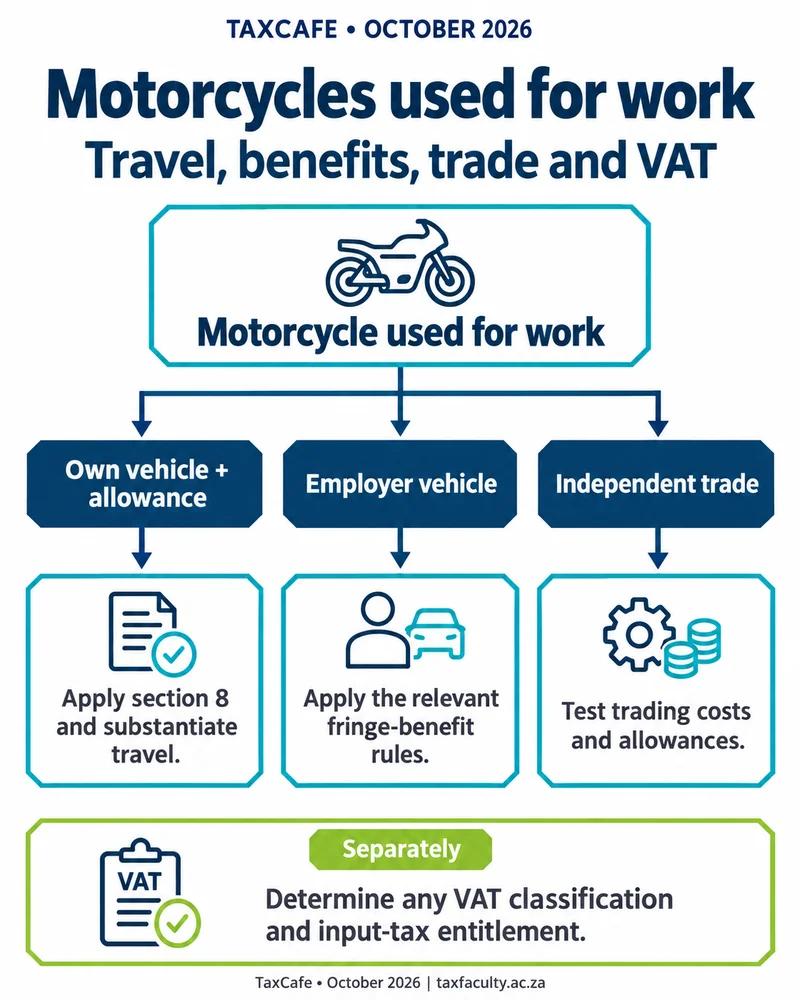
A motorcycle is not disqualified from business-travel treatment merely because the familiar examples use cars. The relevant enquiry concerns the statutory provision, ownership or use arrangement, business kilometres and the evidence supporting the calculation.
The ownership arrangement and the way the rider is paid determine the income-tax enquiry. Value-added tax (VAT) has a separate definition of “motor car” and separate input-tax restrictions. Practitioners should assess each tax under its own provisions and retain the records needed for the travel calculation.
Identify the arrangement before calculating the claim
Section 8(1)(b) of the Income Tax Act 58 of 1962 governs the relevant travel-allowance enquiry. It must be distinguished from the treatment of an employer-provided vehicle under the Seventh Schedule and from the deductions of a person carrying on an independent trade. The same journey can sit within different tax calculations depending on who owns the vehicle and how its use is remunerated.
Obtain the employment agreement, payroll treatment and vehicle details. Establish whether the payment is a fixed allowance, a reimbursement calculated by distance, or another amount. A description on a payslip is evidence to check, not a reason to ignore the actual arrangement.
The South African Revenue Service (SARS) emphasises the logbook and the distinction between business and private travel. Ordinary travel between home and the usual workplace is private for this purpose. A journey does not become business travel because the rider carries a work laptop or leaves home early to avoid traffic. SARS: travel e-logbook.
Client conversation trigger: Ask employees using motorcycles for work to confirm who owns the vehicle and how the employer reimburses or allows for its use before preparing the return.
Maintain a contemporaneous mileage record
Record opening and closing odometer readings and the date, destination, kilometres and business purpose of each qualifying trip. A calendar entry saying “client meeting” should be linked to a journey, rather than treated as proof of an unspecified distance. Service records and other odometer evidence can help identify errors in the annual total.
The calculation must use the appropriate year’s rules and permitted cost basis. If actual costs are used, the records must substantiate the qualifying amounts and their treatment. Capital cost is not automatically an immediate deduction. Fuel, maintenance, insurance and any permitted wear-and-tear component require the applicable analysis, including statutory limitations.
Illustrative example. A motorcycle travels 12 000 kilometres in the year, of which a reliable logbook establishes 4 000 as qualifying business travel. Assume R36 000 is the correctly determined annual cost pool under the applicable actual-cost method, with all limitations already applied. The business proportion is 4 000 ÷ 12 000, producing R12 000 before any allowance-specific limitation. The example does not establish the deductibility of the R36 000 cost pool or replace the statutory calculation.
Where two vehicles are used, keep separate records and allocations. Combining their kilometres while using the costs of only the more expensive vehicle produces an unreliable result. Changes in ownership or periods of availability should also be reflected.
Client conversation trigger: Review motorcycle logbooks during the year and compare the recorded distances with service records, rather than discovering missing evidence after year-end.
Keep VAT and payroll consequences separate
The Value-Added Tax Act 89 of 1991 has its own definition of “motor car” and input-tax restrictions. A vehicle’s classification for that purpose must be tested on the statutory wording and its construction. That classification does not grant an income-tax deduction and does not dispense with a logbook.
Payroll treatment is also separate from the final assessment. The amount included for employees’ tax purposes is not necessarily the final taxable amount after the substantiated travel calculation. The employer should apply the relevant allowance or reimbursement rules and issue an accurate tax certificate. A practitioner should not infer the allowable deduction from the amount subjected to payroll withholding. SARS: travel reimbursement and employees’ tax guidance.
The practical file should contain the vehicle particulars, payment arrangement, logbook, cost evidence and a calculation identifying the method used. Together, those records allow the practitioner to check the claimed amount against the actual journeys and applicable method.
Client conversation trigger: Where the employer’s certificate or reimbursement basis is inconsistent with the actual arrangement, resolve it with payroll before the employee’s return is submitted.
Practitioner action checklist
|
# |
Area |
Issue |
Clients affected |
Action required |
Timing |
|
1 |
Arrangement |
Allowance or provided vehicle |
Employee riders |
Confirm ownership and payment |
Before calculation |
|
2 |
Mileage |
Business versus commuting |
All riders |
Maintain separate logbook |
Each trip |
|
3 |
Costs |
Method and limitations |
Actual-cost claims |
Retain and reconcile evidence |
Annually |
|
4 |
Other taxes |
VAT and payroll |
Vendors/employers |
Apply separate statutory rules |
Before filing |
Keep the payment arrangement, logbook and expense calculation together for each motorcycle used. Reconcile them to the employer’s certificate before filing the return.
Related reading: Establishing a home office deduction for commission earners; Accounting for cash and benefits earned by content creators; Claiming medical tax credits for disability and care costs.
Frequently asked questions
Can I claim a travel allowance for a motorcycle?
A motorcycle is not disqualified merely because familiar examples use cars. The enquiry concerns the statutory provision, the ownership or use arrangement, business kilometres and supporting evidence.
Which section governs a motorcycle travel allowance?
Section 8(1)(b) of the Income Tax Act governs the travel-allowance enquiry. It differs from an employer-provided vehicle under the Seventh Schedule and from deductions of a person carrying on an independent trade.
Is a motorcycle a motor car for VAT?
VAT has a separate definition of motor car and separate input-tax restrictions, so assess each tax under its own provisions.
Build your expertise: to apply these principles in practice, explore The Tax Faculty’s Short Course in Personal Income Tax.
About the author
Dr Stiaan Klue is Executive Dean and CEO of The Tax Faculty. He was the founding CEO of the South African Institute of Taxation (SAIT) and is the founding author of Silke on Tax Administration (LexisNexis).