




CATEGORIES
- (3)AI & Technology
- (52)Accounting & Financial Reporting
- (1)Accounting for Income Tax
- (1)Assessed losses
- (38)Blogs
- (4)Business Advisory
- (8)Capital Gains Tax
- (1)Capital Gains Tax - Individuals Tax
- (1)Capital Gains Tax Implications of Trusts
- (2)Case study: Home office expense
- (1)Case study: Travel allowances
- (1)Company Formations
- (10)Compliance
- (141)Corporate Tax
- (15)Customs and Excise
- (2)Deceased Estate
- (1)Deductions Pre-trade and prepaid expenses
- (1)Deregistration
- (2)Employer and Employee (PAYE and UIF Specific)
- (1)Estate Duty
- (1)Events / Webinars
- (11)Faculty News
- (2)Farming
- (177)Individuals Tax
- (1)Input - Customs Duty
- (3)Interest
- (23)International Tax
- (1)Nature of the rights of beneficiaries
- (1)Notional input tax
- (10)Payroll
- (1)People & Practice Management
- (2)Practical Payroll
- (1)Professional Ethics
- (2)Provisional tax (Link with other Taxes)
- (4)SARS Issues
- (178)Tax Administration
- (2)Tax Administration Part 2B: Resolving Problems with SARS using the Tax Ombud
- (1)Tax Administration Part 3B Dispute Resolution - Objection and appeal
- (8)Tax Dispute Resolution
- (1)Tax Opinions
- (3)Tax Update
- (1)Tax implications of loans to trusts
- (1)Tax residence
- (1)Tax returns and payments
- (3)Transfer-Pricing
- (1)Trust Income / Gain Allocations
- (1)Trust types and income allocations
- (12)Trusts
- (88)VAT
- (3)VAT periods
- (1)Wear and tear allowances
- (14)Wills, Estates & Succession
- (1)Zero Rated
- (2)eFiling
- Show All

Allocating rental income between spouses
- 28 October 2026
- Individuals Tax
- Dr Stiaan Klue
Source: TaxCafe, Carmen Westermeyer CA(SA), October 2026. Available on Webinar-on-Demand: TaxCafe with Carmen Westermeyer - October 2026
At a glance
|
Arrangement |
Starting enquiry |
Reporting consequence |
|
Property in a joint estate |
Matrimonial regime and statutory allocation |
Apply the relevant spousal attribution rules |
|
Co-owned property |
Ownership and entitlement to income |
Allocate on the established legal basis |
|
Actual partnership |
Agreement and conduct of the business |
Consider annual IT3(BO) reporting |
|
Shared bank account |
Who owns and earns the amounts? |
Banking arrangements alone are insufficient |
Two spouses receiving rent from one property do not become partners merely because both must report income. Conversely, a marriage does not prevent spouses from entering a genuine business partnership. The legal arrangement must be identified before completing a return’s partnership fields.
The Beneficial Owner Register IT3(BO) adds a reporting step for actual partnerships. It should be used only after the arrangement has been classified. For spouses holding rental property, the first task is to establish ownership, the matrimonial regime and any agreement to carry on business together.
Establish ownership and the matrimonial consequences
Begin with the title deed, acquisition documents and matrimonial regime. Where spouses are married in community of property, determine whether the property forms part of the joint estate and apply the relevant provisions of section 7 of the Income Tax Act 58 of 1962, including section 7(2A). Do not infer the allocation from the bank account into which the tenant pays.
For property outside a joint estate, establish the ownership shares and the legal entitlement to income. A spouse who administers the property does not necessarily own half the rental income. A transfer of money between spouses after rent has accrued also does not necessarily change who earned it.
The South African Revenue Service (SARS) rental guidance explains that, for joint-estate property, its return process can apportion rental profit or loss between spouses. Practitioners should follow the current return instructions and inspect the calculation, avoiding the mistake of manually halving an amount that the system will halve again. SARS: tax on rental income.
Client conversation trigger: Ask married rental clients for proof of ownership and their matrimonial regime, then reconcile both spouses’ calculations to the property's full annual result.
Decide whether the arrangement is a partnership
A partnership enquiry concerns the agreement and the conduct of the enterprise: what each person contributes, the business carried on for their joint benefit and the profit-making purpose. Co-ownership of an asset is not, without more, the same thing. A written agreement is useful evidence and good practice, but the absence of one does not conclusively establish that no partnership exists.
The distinction matters beyond a form. Partnership accounts should explain capital, drawings, profit shares and changes in membership. A simple co-ownership schedule may instead record each owner’s entitlement and share of expenses. Imposing partnership terminology on a co-ownership arrangement can produce inconsistencies between the return, title deed and legal position.
Illustrative example. Spouses own a property outside a joint estate in established 60:40 shares. Assume the net taxable rental result is R100 000 and that no partnership or other attribution rule changes their entitlements. The starting allocation is R60 000 and R40 000. Paying all the rent into one spouse’s account does not justify declaring all R100 000 in that spouse’s return. The example depends on the stated ownership and legal assumptions.
Where the facts instead disclose an actual partnership, document it accurately. Do not create a retrospective agreement merely to support a preferred return answer. Any uncertainty should be resolved before the tax positions of the spouses diverge.
Client conversation trigger: For clients currently declaring a rental “partnership”, compare the agreement, ownership and accounts and confirm whether that description is legally supportable.
Complete IT3BO only for the arrangement it addresses
SARS’s partnership process uses a designated representative to submit partners’ information through the Beneficial Owner Register IT3(BO). Its May 2026 guidance calls for submission before the related individual income-tax return (ITR12) and for use of the correct year. The resulting unique number links the partnership information to the individual return. SARS: partnership IT3(BO) guidance.
This administrative process does not decide whether a partnership exists and does not replace the substantive income allocation. The representative should circulate the accepted information and number to the partners, while each partner remains responsible for the accuracy of their return.
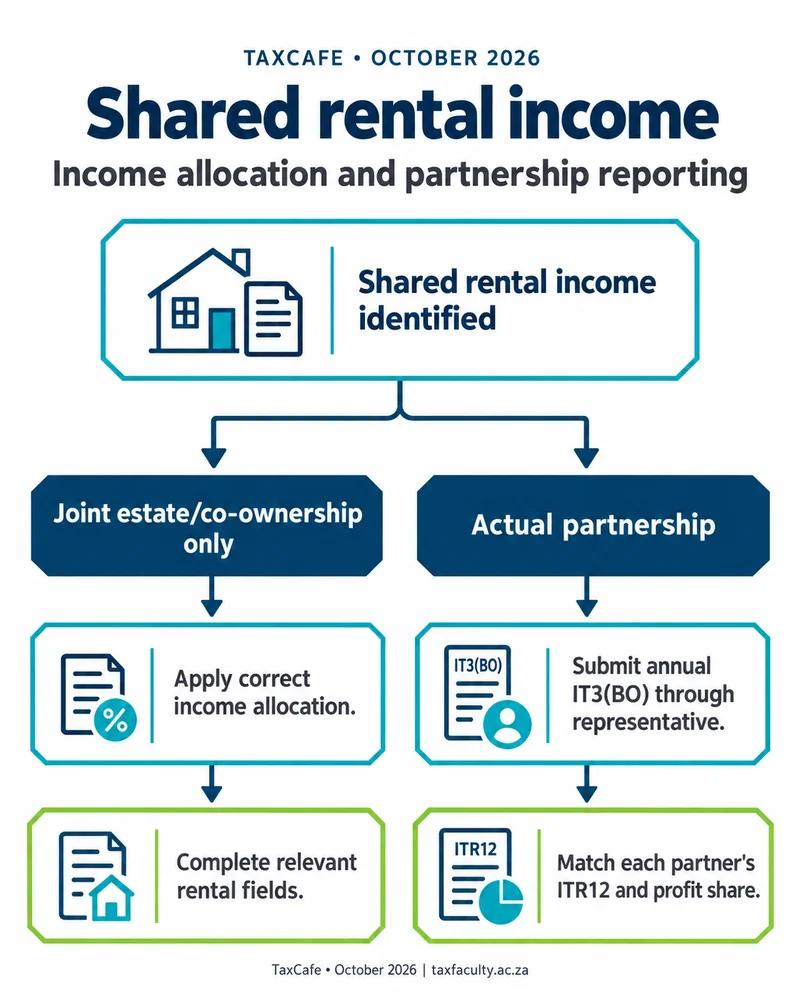 Reconcile the whole property or enterprise before dividing its result. Shared expenses should not be claimed in full by both spouses, and allocations should not leave part of the rent undeclared. A combined reconciliation is often the simplest way to detect both errors.
Client conversation trigger: Where a genuine partnership exists, nominate the reporting representative and agree a single annual schedule that both partners will use.
Practitioner action checklist
|
# |
Area |
Issue |
Clients affected |
Action required |
Timing |
|
1 |
Ownership |
Legal entitlement |
Married landlords |
Check title and matrimonial regime |
Before allocation |
|
2 |
Classification |
Partnership or co-ownership |
Shared rentals |
Record legal basis |
Before IT3(BO) |
|
3 |
Reporting |
Annual partnership record |
Actual partners |
Submit and distribute unique number |
Before ITR12 |
|
4 |
Calculation |
Omission or double claim |
Both spouses |
Reconcile combined result |
Before submission |
Reconcile the full rental result to each spouse’s legal entitlement and return. Where a partnership exists, its accepted reporting information should agree with that same allocation.
Related reading: Allocating rental income after the death of a landlord; Testing deductions and losses on family rentals; Claiming medical tax credits for disability and care costs.
Frequently asked questions
How do spouses married in community of property declare rental income?
Determine whether the property forms part of the joint estate and apply the relevant provisions of section 7 of the Income Tax Act, including section 7(2A). Do not infer the allocation from the bank account into which the tenant pays.
Are spouses who share rental income automatically partners?
No. Two spouses receiving rent from one property do not become partners merely because both must report income, although spouses can enter a genuine business partnership.
When must spouses complete the IT3(BO) partnership return?
The IT3(BO) adds a reporting step for actual partnerships. It should be used only after the arrangement has been classified as a partnership.
Build your expertise: to apply these principles in practice, explore The Tax Faculty’s Short Course in Personal Income Tax.
About the author
Dr Stiaan Klue is Executive Dean and CEO of The Tax Faculty. He was the founding CEO of the South African Institute of Taxation (SAIT) and is the founding author of Silke on Tax Administration (LexisNexis).