




CATEGORIES
- (3)AI & Technology
- (52)Accounting & Financial Reporting
- (1)Accounting for Income Tax
- (1)Assessed losses
- (38)Blogs
- (4)Business Advisory
- (8)Capital Gains Tax
- (1)Capital Gains Tax - Individuals Tax
- (1)Capital Gains Tax Implications of Trusts
- (2)Case study: Home office expense
- (1)Case study: Travel allowances
- (1)Company Formations
- (10)Compliance
- (141)Corporate Tax
- (15)Customs and Excise
- (2)Deceased Estate
- (1)Deductions Pre-trade and prepaid expenses
- (1)Deregistration
- (2)Employer and Employee (PAYE and UIF Specific)
- (1)Estate Duty
- (1)Events / Webinars
- (11)Faculty News
- (2)Farming
- (177)Individuals Tax
- (1)Input - Customs Duty
- (3)Interest
- (23)International Tax
- (1)Nature of the rights of beneficiaries
- (1)Notional input tax
- (10)Payroll
- (1)People & Practice Management
- (2)Practical Payroll
- (1)Professional Ethics
- (2)Provisional tax (Link with other Taxes)
- (4)SARS Issues
- (178)Tax Administration
- (2)Tax Administration Part 2B: Resolving Problems with SARS using the Tax Ombud
- (1)Tax Administration Part 3B Dispute Resolution - Objection and appeal
- (8)Tax Dispute Resolution
- (1)Tax Opinions
- (3)Tax Update
- (1)Tax implications of loans to trusts
- (1)Tax residence
- (1)Tax returns and payments
- (3)Transfer-Pricing
- (1)Trust Income / Gain Allocations
- (1)Trust types and income allocations
- (12)Trusts
- (88)VAT
- (3)VAT periods
- (1)Wear and tear allowances
- (14)Wills, Estates & Succession
- (1)Zero Rated
- (2)eFiling
- Show All

Resolving retirement directives and missing transfer records
- 28 October 2026
- Individuals Tax
- Dr Stiaan Klue
Source: TaxCafe, Carmen Westermeyer CA(SA), October 2026. Available on Webinar-on-Demand: TaxCafe with Carmen Westermeyer - October 2026
At a glance
|
Document or process |
Purpose |
Responsible parties |
|
Tax directive |
Directs tax treatment/withholding for the stated transaction |
Applying fund or administrator and SARS |
|
IRP5/IT3(a) certificate |
Reports the benefit and tax |
Issuing fund or employer |
|
ROT01 |
Confirms a relevant fund-to-fund transfer was received |
Transferring and receiving funds |
|
ROT02 |
Recognition of purchase of an annuity |
Relevant fund/insurer parties |
|
ITR12 validation |
Checks the return against available records |
Taxpayer/practitioner, after source correction |
A retirement-related return can be blocked even though the taxpayer has supplied every document in their possession. The unresolved record may sit with a fund or insurer: an incorrect directive, missing certificate or unsubmitted recognition of transfer. The practitioner needs to identify the missing link and the party able to correct it.
Address missing fund records early enough to allow the responsible institution to investigate. Repeated changes to the individual income-tax return (ITR12) cannot correct a transaction recorded incorrectly by a fund or insurer. Match the directive, certificate and transfer evidence before requesting a specific correction.
Reconcile the directive certificate and actual transaction
The Second Schedule to the Income Tax Act 58 of 1962 and the relevant employees’ tax provisions govern the tax treatment of retirement lump sums and transfers. A directive relates to stated facts. Verify the member, tax reference, fund, transaction reason, amount, accrual date and directive number against the actual benefit and the certificate.
Distinguish a withdrawal, retirement benefit, death benefit, permitted transfer and annuity purchase. These are not interchangeable events. A certificate showing a lump sum cannot safely be deleted merely because the taxpayer recalls that the money went directly to another fund. The underlying records must explain whether it was a qualifying transfer and how it was reported.
Illustrative example. A directive records a transfer of R600 000 from Fund A to Fund B. Fund B receives the money but no accepted recognition record appears on the South African Revenue Service (SARS) system. Adding or removing R600 000 on the taxpayer’s return does not establish that Fund B completed the required confirmation. The funds must reconcile the transfer and resolve the source record.
Client conversation trigger: For clients who moved retirement benefits during the year, obtain the directive, certificates and receiving-fund confirmation well before preparing the ITR12.
Understand what ROT01 confirms
ROT01 is the recognition-of-transfer form used for relevant transfers between funds. Its purpose is for the receiving fund to confirm receipt of the amount reflected in the transferring fund’s directive process. ROT02 addresses recognition of an annuity purchase in the relevant circumstances. The form, identity details and directive reference must match the transaction.
SARS’s current guide explains completion, submission, enquiry and cancellation procedures. It also states that outstanding recognitions up to 28 February 2023 are no longer required. An old item should therefore be checked against that published treatment rather than automatically pursued as though every historical transfer remains subject to the same outstanding requirement. SARS: recognition-of-transfer guide.
The practitioner should request the actual submission outcome, not merely an assurance that a form was sent. Rejection messages may identify a mismatched tax number, passport detail, directive or amount. Those discrepancies should be corrected by the appropriate source party. A signed paper copy can be useful evidence without proving that an electronic record was accepted.
Client conversation trigger: Where a ROT01 is said to be outstanding, ask the receiving fund for its submission reference, status and any rejection message, then compare these with the original directive.
Coordinate correction and protect the filing position
Create a case schedule linking the taxpayer, transferring fund, receiving fund, directive, certificate and recognition record. Assign a named contact at each fund and record the precise correction required. The instruction should say which identifier or amount differs and what evidence establishes the correct value.
Cancellation is not a harmless reset. The funds must follow the prescribed sequence for cancelling a recognition and, where appropriate, the directive and related transaction. SARS’s guide distinguishes a submitted cancellation request from an actual cancelled status. A practitioner should not encourage cancellation of a valid directive simply to bypass a return validation. SARS: current electronic ROT procedures.
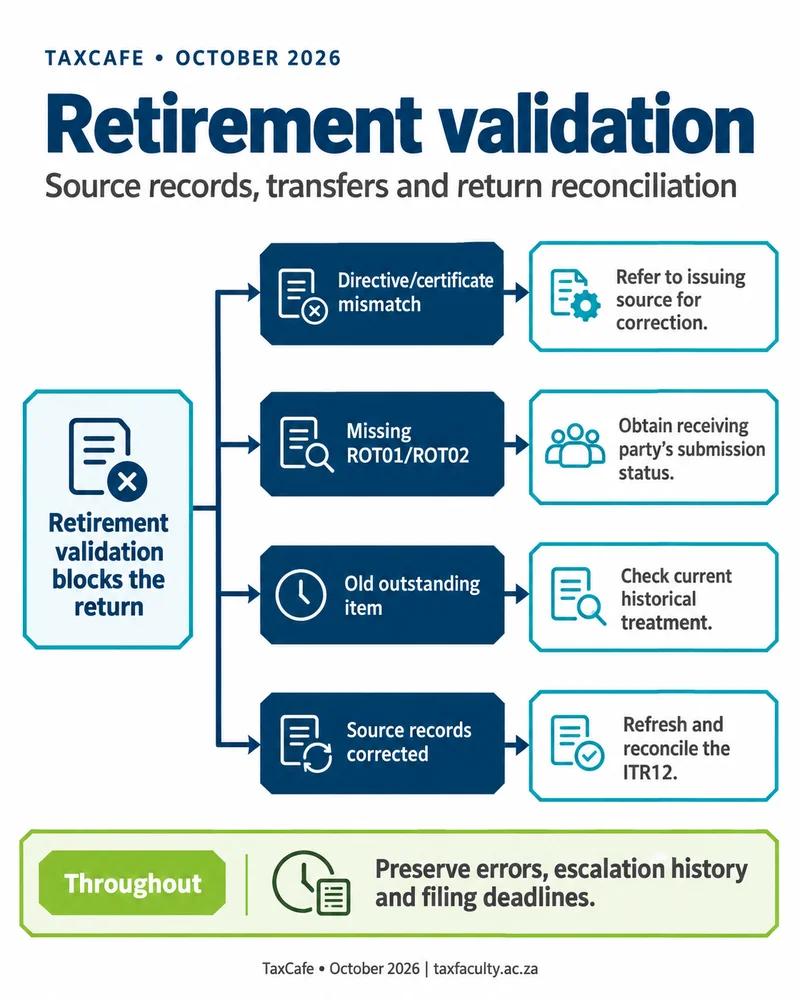
If the deadline is imminent, retain the error, the completed return information, fund correspondence and evidence of timely attempts to resolve the block. Escalate through the available SARS process and assess any later penalty remedy on its merits. A system problem does not automatically grant an extension or remission.
Client conversation trigger: For blocked returns, agree a dated escalation plan with the fund administrators and retain the evidence needed to explain any filing delay.
Practitioner action checklist
|
# |
Area |
Issue |
Clients affected |
Action required |
Timing |
|
1 |
Transaction |
Incorrect benefit category |
Retirement clients |
Match facts, directive and certificate |
Before ITR12 |
|
2 |
Recognition |
Missing or rejected ROT |
Transfer/annuity cases |
Obtain receiving-party status |
Early in filing cycle |
|
3 |
Correction |
Source data mismatch |
Blocked returns |
Assign precise correction to fund |
Immediately |
|
4 |
Cancellation |
Sequence and consequences |
Incorrect transactions |
Follow prescribed process |
Before cancellation |
|
5 |
Deadline |
Unresolved validation |
Affected taxpayers |
Preserve evidence and escalate |
Before due date |
Obtain confirmation that the fund’s corrected record was accepted, then reconcile and complete the return. Preserve the escalation history and filing evidence where the delay has created a separate penalty issue.
Related reading: Resolving payroll submission and reconciliation failures; Claiming medical tax credits for disability and care costs; Responding to verification requests and identifying audit.
Frequently asked questions
Who corrects an incorrect retirement fund tax directive?
The fund or insurer that recorded the transaction. Repeated changes to the ITR12 cannot correct a transaction recorded incorrectly by a fund or insurer.
Can I delete a lump sum certificate if the money went to another fund?
Not safely. The underlying records must explain whether it was a qualifying transfer and how it was reported.
What should I check on a tax directive?
Verify the member, tax reference, fund, transaction reason, amount, accrual date and directive number against the actual benefit and certificate.
Build your expertise: to apply these principles in practice, explore The Tax Faculty’s Short Course in Personal Income Tax.
About the author
Dr Stiaan Klue is Executive Dean and CEO of The Tax Faculty. He was the founding CEO of the South African Institute of Taxation (SAIT) and is the founding author of Silke on Tax Administration (LexisNexis).