




CATEGORIES
- (3)AI & Technology
- (52)Accounting & Financial Reporting
- (1)Accounting for Income Tax
- (1)Assessed losses
- (38)Blogs
- (4)Business Advisory
- (8)Capital Gains Tax
- (1)Capital Gains Tax - Individuals Tax
- (1)Capital Gains Tax Implications of Trusts
- (2)Case study: Home office expense
- (1)Case study: Travel allowances
- (1)Company Formations
- (10)Compliance
- (141)Corporate Tax
- (15)Customs and Excise
- (2)Deceased Estate
- (1)Deductions Pre-trade and prepaid expenses
- (1)Deregistration
- (2)Employer and Employee (PAYE and UIF Specific)
- (1)Estate Duty
- (1)Events / Webinars
- (11)Faculty News
- (2)Farming
- (177)Individuals Tax
- (1)Input - Customs Duty
- (3)Interest
- (23)International Tax
- (1)Nature of the rights of beneficiaries
- (1)Notional input tax
- (10)Payroll
- (1)People & Practice Management
- (2)Practical Payroll
- (1)Professional Ethics
- (2)Provisional tax (Link with other Taxes)
- (4)SARS Issues
- (178)Tax Administration
- (2)Tax Administration Part 2B: Resolving Problems with SARS using the Tax Ombud
- (1)Tax Administration Part 3B Dispute Resolution - Objection and appeal
- (8)Tax Dispute Resolution
- (1)Tax Opinions
- (3)Tax Update
- (1)Tax implications of loans to trusts
- (1)Tax residence
- (1)Tax returns and payments
- (3)Transfer-Pricing
- (1)Trust Income / Gain Allocations
- (1)Trust types and income allocations
- (12)Trusts
- (88)VAT
- (3)VAT periods
- (1)Wear and tear allowances
- (14)Wills, Estates & Succession
- (1)Zero Rated
- (2)eFiling
- Show All

Defining representative roles for nonresident clients
- 28 October 2026
- Tax Administration
- Dr Stiaan Klue
Source: TaxCafe, Carmen Westermeyer CA(SA), October 2026. Available on Webinar-on-Demand: TaxCafe with Carmen Westermeyer - October 2026
At a glance
|
Role |
Basis |
Key distinction |
|
Public officer |
Statutory company representative |
|
|
Representative taxpayer |
Applicable tax provision and sections 153–155 |
Capacity-specific duties and possible liability |
|
Tax practitioner |
Professional mandate and registration |
Not automatically the public officer |
|
eFiling user |
System authority |
Access does not itself determine legal capacity |
An overseas client may ask a practitioner to “be the representative” without identifying the office, tax type or legal responsibility involved. A simple access request can then become a statutory appointment that neither party has properly considered.
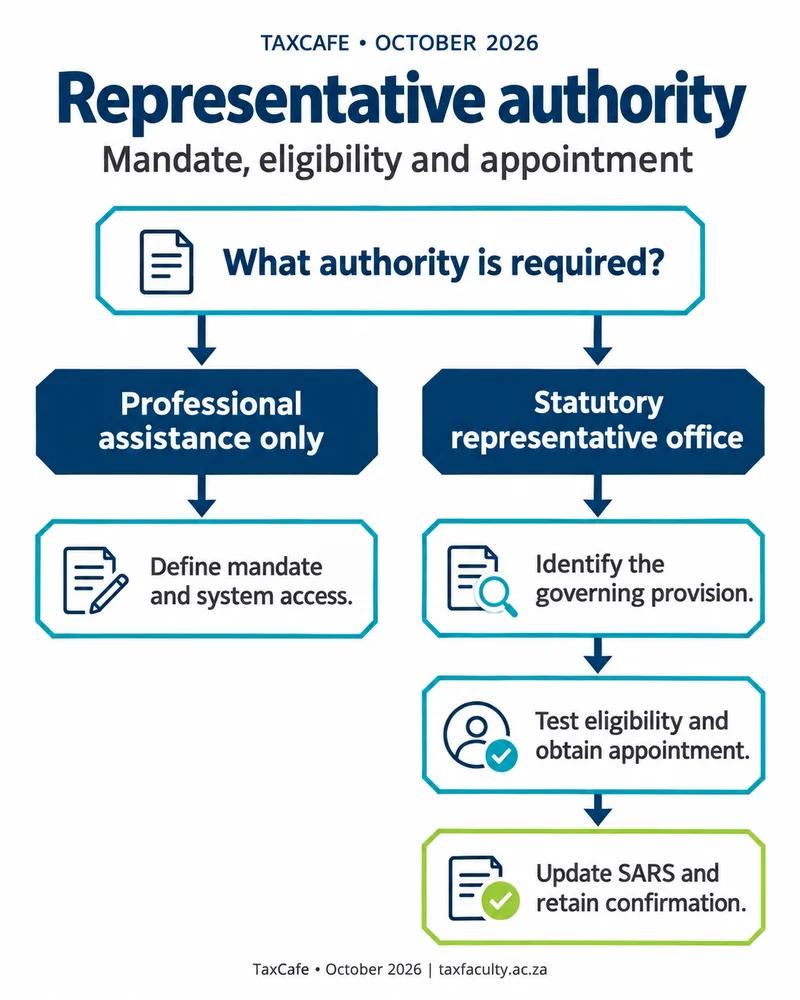
The engagement should identify the statutory office and the authority needed to perform it. A company’s public officer, a representative taxpayer and a practitioner authorised to file returns may have different responsibilities. The distinction matters both when accepting the appointment and when ending it.
Start with the entity and the statutory office
Section 246 of the Tax Administration Act 28 of 2011 requires a company carrying on business or having an office in South Africa to be represented by an individual residing in the Republic. The public officer must ordinarily be a senior official of the company. Where no senior official resides in the Republic, the provision allows another suitable person approved by the South African Revenue Service (SARS).
The statutory wording concerns residence in the Republic for the office concerned. It should not be replaced casually with citizenship or immigration labels. Nor should a broad website description of “representative taxpayer” be treated as a complete statement of every representative category. The Income Tax Act 58 of 1962, Value-Added Tax Act 89 of 1991 and other applicable provisions must be considered for the relevant capacity. SARS: representative-taxpayer guidance; Tax Administration Act.
A foreign shareholder, a director living abroad and a local public officer can be different people. The corporate relationship does not eliminate the need for a compliant appointment. A company should retain the resolution, acceptance, supporting identity and address evidence, and SARS confirmation of the registered particulars.
The current section 246 also provides a deemed appointment mechanism if the company fails to appoint a public officer. It uses a hierarchy of eligible officeholders, beginning with the managing director or equivalent, or a suitable person designated by SARS. Under section 246(7), ineligibility or a SARS notification of unsuitability triggers a requirement to notify SARS in writing of the replacement within 21 business days. Leaving the position unfilled is therefore not a way to avoid responsibility. Tax Administration Laws Amendment Act 43 of 2024, section 31.
Client conversation trigger: Review foreign-owned clients’ public-officer appointments and confirm that the named person still occupies an appropriate role and resides where the statute requires.
Distinguish authority to act from liability for tax
Sections 153 to 155 of the Tax Administration Act deal with representative taxpayers, their liability in that capacity and circumstances in which personal liability may arise. It is inaccurate to say that accepting any representative role automatically makes the individual personally liable for all the taxpayer’s debts. It is equally unsafe to assume the appointment has no consequences beyond forwarding correspondence.
The practitioner should understand what money or assets the representative controls and whether distributions could leave tax unpaid. Section 155 addresses specified conduct involving alienation or disposal of relevant money and parting with funds from which tax could legally have been paid. The facts and statutory requirements matter; an engagement letter cannot displace the legislation.
A mandate should identify the office accepted, the tax types covered, authority to obtain records, access to management and the process for approving submissions. The client must understand that the representative needs information and cannot responsibly certify facts that management withholds. The mandate should provide a way to obtain missing records and escalate management’s failure to supply them.
Client conversation trigger: Before accepting or renewing a statutory appointment, discuss access to records, control of funds, reporting obligations and the process for withholding distributions while tax exposure is assessed.
Make appointment and departure part of the compliance process
The eFiling profile should reflect the legal appointment accurately. A tax practitioner’s authority to submit returns under a power of attorney should not be confused with appointment as public officer. Likewise, the departure of an employee who held the office should trigger a replacement and record update, rather than leaving an obsolete name on the system.
A handover should list outstanding returns, assessments, disputes, payment arrangements and unresolved queries. It should also identify where the supporting records are held. Removing an eFiling link is not necessarily the same as ending a statutory appointment, and resignation should be communicated through the appropriate legal and administrative steps.
Non-resident individuals should also be distinguished from companies. A question about a company’s public officer does not answer whether an individual must appoint a representative for a particular tax matter. Apply the provision to the actual taxpayer, rather than generalising from one category to another.
Client conversation trigger: When a director, employee or adviser leaves, arrange a documented representative handover and confirm the effective update of SARS records.
Practitioner action checklist
|
# |
Area |
Issue |
Clients affected |
Action required |
Timing |
|
1 |
Capacity |
Unclear representative role |
Non-resident clients |
Identify statutory office or mandate |
Before acceptance |
|
2 |
Eligibility |
Public-officer requirements |
Companies |
Check section 246 and appointment |
On appointment |
|
3 |
Exposure |
Control of records and funds |
Representatives |
Assess duties and liability provisions |
Before distributions |
|
4 |
Continuity |
Obsolete appointment |
Departing representatives |
Complete replacement and handover |
On departure |
Accept the appointment only with a defined mandate and access to the information needed to perform the role. Record changes and complete the statutory and administrative handover when the appointment ends.
Related reading: Distinguishing foreign employment from independent consulting; Protecting the tax position when foreign income fields change; Testing the tax exemption for seafarers and yacht crew.
Frequently asked questions
Does a foreign company need a public officer in South Africa?
Section 246 of the Tax Administration Act requires a company carrying on business or having an office in South Africa to be represented by an individual residing in the Republic. Ordinarily this is a senior official, or another suitable person approved by SARS.
Is a representative taxpayer the same as a tax practitioner?
No. A company’s public officer, a representative taxpayer and a practitioner authorised to file returns may have different responsibilities. The distinction matters when accepting and ending the appointment.
Must the public officer be a South African citizen?
The statutory wording concerns residence in the Republic for the office concerned. It should not be replaced casually with citizenship or immigration labels.
Build your expertise: to apply these principles in practice, explore The Tax Faculty’s Short Course in International Tax.
About the author
Dr Stiaan Klue is Executive Dean and CEO of The Tax Faculty. He was the founding CEO of the South African Institute of Taxation (SAIT) and is the founding author of Silke on Tax Administration (LexisNexis).