

This article is based on tax law for the year ending 29 February 2025.
Questions:
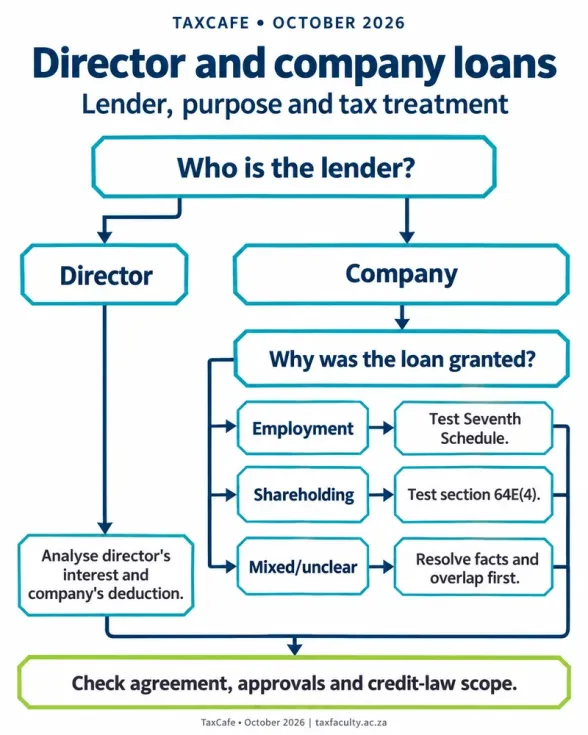
Section 64E(4) of the Income Tax Act states that a loan provided to an individual shareholder (who is not a company) will be deemed a dividend and subject to dividend tax. The value of the dividend is calculated as the interest that would have been charged at prime less 2.5%, minus any interest actually charged.
Does this also apply to credit loan accounts?
For instance, if a shareholder has a credit loan account and opts to charge the company only 6.5% interest, the following questions arise:
-
Can the "difference" be regarded as a donation from the shareholder to the company, and would the R100 000 annual donations tax exemption then apply?
-
Should the shareholder declare only the actual interest received in their tax return, or should they also include the portion that was "donated"?
-
Is Section 64E(4) the correct provision to apply in this case, or should another section of the Income Tax Act be referenced instead?
Answers:
1. The Problem / Facts
A shareholder has provided a loan to the company at an interest rate of 6.5%, which is below the benchmark rate (prime less 2.5%).
- Question 1: Can the "difference" be regarded as a donation from the shareholder to the company, and will the R100,000 exclusion for donations tax then apply?
- Question 2: Should the shareholder declare only the actual interest received in their tax return, or should they include the portion effectively "donated"?
- Question 3: Is Section 64E(4) the correct provision to apply, or should another section of the Income Tax Act be used?
2. Applicable Law
- Deemed Dividends: Income Tax Act – Section 64E(4)
- Donations Tax: Income Tax Act – Section 56(2)(b)
- Interest Declaration: Income Tax Act – Section 24J
- Annual Donations Tax Exemption: Income Tax Act – Section 56(2)(b)
3. Application of the Law to the Facts
- Question 1: Can the "difference" be regarded as a donation, and will the R100,000 exclusion for donations tax be applicable?
- The difference between the official rate (prime plus 1) and the 6.5% interest rate charged may be considered a donation from the shareholder to the company. Donations tax could apply to this amount, but the shareholder may utilise the annual R100,000 exemption under Section 56(2)(b) of the Income Tax Act to offset potential liability.
- Question 2: Should the shareholder declare only the actual interest received in their tax return, or should they include the "donated" portion?
- The shareholder will declare only the actual interest received (6.5% of the loan amount) as taxable income. The "donated" portion is not regarded as interest income for their personal tax return but may have donations tax implications.
- Question 3: Is Section 64E(4) the correct provision to use, or should another section of the Income Tax Act apply?
- The donations tax provisions under Section 56(2)(b) are relevant in determining whether the interest differential qualifies as a donation.
Frequently asked questions
Does section 64E(4) automatically tax a below-benchmark interest charge on a credit loan account as a deemed dividend?
Not in the scenario discussed. Section 64E(4) is aimed at under-charged interest on loans to individual shareholders; the article treats a shareholder charging the company below the official rate as raising donations-tax questions instead.
If a shareholder charges the company less interest than the official rate, can the difference be a donation?
The article says the interest differential may be treated as a donation from the shareholder to the company, with the annual donations-tax exemption under section 56(2)(b) potentially available.
What interest must the shareholder declare on their tax return?
Only the interest actually received. The foregone portion is not treated as interest income on the shareholder return, though it may still have donations-tax consequences.
Which provisions should practitioners check first in this fact pattern?
Donations-tax rules under section 56(2)(b), interest timing under section 24J, and whether section 64E(4) truly fits a credit loan from shareholder to company.