




CATEGORIES
- (3)AI & Technology
- (52)Accounting & Financial Reporting
- (1)Accounting for Income Tax
- (1)Assessed losses
- (38)Blogs
- (4)Business Advisory
- (8)Capital Gains Tax
- (1)Capital Gains Tax - Individuals Tax
- (1)Capital Gains Tax Implications of Trusts
- (2)Case study: Home office expense
- (1)Case study: Travel allowances
- (1)Company Formations
- (10)Compliance
- (141)Corporate Tax
- (15)Customs and Excise
- (2)Deceased Estate
- (1)Deductions Pre-trade and prepaid expenses
- (1)Deregistration
- (2)Employer and Employee (PAYE and UIF Specific)
- (1)Estate Duty
- (1)Events / Webinars
- (11)Faculty News
- (2)Farming
- (177)Individuals Tax
- (1)Input - Customs Duty
- (3)Interest
- (23)International Tax
- (1)Nature of the rights of beneficiaries
- (1)Notional input tax
- (10)Payroll
- (1)People & Practice Management
- (2)Practical Payroll
- (1)Professional Ethics
- (2)Provisional tax (Link with other Taxes)
- (4)SARS Issues
- (178)Tax Administration
- (2)Tax Administration Part 2B: Resolving Problems with SARS using the Tax Ombud
- (1)Tax Administration Part 3B Dispute Resolution - Objection and appeal
- (8)Tax Dispute Resolution
- (1)Tax Opinions
- (3)Tax Update
- (1)Tax implications of loans to trusts
- (1)Tax residence
- (1)Tax returns and payments
- (3)Transfer-Pricing
- (1)Trust Income / Gain Allocations
- (1)Trust types and income allocations
- (12)Trusts
- (88)VAT
- (3)VAT periods
- (1)Wear and tear allowances
- (14)Wills, Estates & Succession
- (1)Zero Rated
- (2)eFiling
- Show All

Reportable arrangements: put the disclosure decision into the transaction file
- 27 October 2026
- Compliance
- Dr Stiaan Klue
Source: Monthly Tax Update, Professor Jackie Arendse, October 2026. Webinar-on-Demand: Monthly SARS Update with Prof Jackie Arendse - October 2026
At a glance
|
Issue |
Requirement |
Practice consequence |
|
Classification |
Test section 35, applicable public notices and section 36 exclusions. |
Keep a reasoned reporting decision for material arrangements. |
|
Timing |
Generally 45 business days; a further 45 may be allowed on reasonable grounds. |
Identify the trigger and diary the deadline separately from the tax return. |
|
Multiple participants |
Reliance on another participant requires a written statement confirming disclosure. |
An informal assurance is not the control described in the guide. |
|
Penalties |
Monthly amounts differ for promoters and other participants, with escalation for larger tax benefits. |
Identify the client’s role and quantify exposure. |
|
Reference number |
Disclosure is not approval of the arrangement. |
Do not describe a reference number as tax clearance. |
The updated reportable-arrangement guide should prompt a review of transaction intake procedures. The relevant question is not simply whether the accountant believes a structure is lawful. An arrangement may require disclosure under the Tax Administration Act even where the participant considers its tax treatment defensible. Conversely, complexity or a tax saving alone does not establish reportability without applying the statutory triggers and exclusions.
The practical weakness is often ownership of the decision. Lawyers prepare agreements, finance teams approve funding, and advisers calculate the tax result, but no one records who will assess the disclosure obligation. That omission can outlast the transaction and generate monthly penalties.
Start with the arrangement and the participant
The statutory concept of an arrangement extends beyond a single enforceable contract. The review must capture the transaction, operation, scheme, agreement or understanding and, where relevant, the larger series of steps. Looking at an isolated leg can conceal the features that determine whether reporting is required.
Section 35 and the public notices identify reportable categories. Features warranting scrutiny include tax-sensitive financing charges, arrangements with specified avoidance characteristics, certain differences between accounting and tax treatment, and inadequate pre-tax returns relative to the anticipated tax benefit. These are screening indicators, not a substitute for matching the actual facts to the statutory text and any notice.
Section 36 exclusions also require their conditions to be met. An arrangement does not become excluded merely because it is labelled a loan or lease. The file should identify the precise exclusion relied on and explain why the circumstances satisfy it. The guide refers to Notice 140 in Government Gazette 39650 of 3 February 2016; the applicable notice and category should be checked for the actual transaction.
The review must identify participants and any promoter. A client deriving a benefit should not assume the reporting obligation rests only with the firm that designed the structure. Advisers should also assess their own role where they organise, design, sell, finance or manage an arrangement, rather than assume that their professional title answers the statutory definition.
Client conversation trigger: For a material financing, restructuring or investment transaction, require a documented reportable-arrangement review covering the full series of steps and each participant’s role.
The reporting clock is separate from annual compliance
The guide states that disclosure must generally occur within 45 business days after the arrangement becomes reportable, or within 45 business days after a person becomes a participant in an existing reportable arrangement. SARS may allow a further 45 business days where reasonable grounds exist. An extension should be sought and documented, not assumed.
The annual income-tax return is therefore a poor reminder system. A transaction concluded shortly after year-end may require disclosure long before the next return is prepared. The engagement file should record the triggering event, calculation of business days, responsible person, review date and submission evidence.
Where another participant reports, the guide permits reliance on a written statement confirming that the arrangement has been disclosed. A transaction meeting note saying that “the promoter will handle SARS” is not equivalent to confirmation that disclosure has occurred. Obtain the statement and link it to the precise arrangement and participants; retain the reference and underlying material available to support the client’s treatment.
Client conversation trigger: Ask clients participating in externally designed arrangements for the actual written disclosure confirmation, rather than accepting an assurance that reporting is someone else’s responsibility.
Prepare a disclosure that explains the whole transaction
The guide directs taxpayers to submit the RA01 form and supporting documents through eFiling. The required information includes the steps and key features of the arrangement, anticipated tax benefits, participant details, agreements and financial models embodying the projected tax treatment.
The accountant’s contribution is to reconcile the financial model to the agreements and proposed return treatment. For example, a model showing a deduction should identify the taxpayer, provision, year and assumptions on which the deduction depends. The description should also explain steps in the larger arrangement where the disclosed transaction forms only one part of it.
Reporting does not secure approval. The South African Revenue Service (SARS) may seek further information, and the allocated reference number confirms administrative receipt or identification rather than acceptance of the tax result. A separate technical opinion may still be needed. Client reporting should keep those functions distinct: disclosure compliance, substantive tax analysis and any binding ruling are different matters.
Client conversation trigger: Review client board papers and transaction summaries for statements implying that a reportable-arrangement reference number validates the tax treatment.
Quantify penalty exposure before it accumulates
Section 212 provides monthly penalties for the relevant reporting failures, for up to twelve months. The guide sets out the following base amounts and escalations.
|
Role or circumstance |
Penalty treatment |
|
Participant or intermediary other than promoter, within the relevant statutory category |
R50,000 per month, up to 12 months |
|
Promoter |
R100,000 per month, up to 12 months |
|
Anticipated tax benefit exceeds R5 million |
Relevant monthly amount doubled |
|
Anticipated tax benefit exceeds R10 million |
Relevant monthly amount tripled |
An editorial illustration: three months of a qualifying failure at the unenhanced rate produces R150,000 for a non-promoter participant or R300,000 for a promoter. The calculation assumes the relevant category, no escalation and three chargeable months. It is not a prediction that every late disclosure attracts that amount or that remission is unavailable.
The R5 million and R10 million figures in this table concern penalty escalation. They should not be used as a universal exemption from disclosure for all smaller transactions. Classification and penalties are separate enquiries, and the specific notice or exclusion must be applied on its own terms.
Client conversation trigger: Where a reporting omission is discovered, determine the trigger date and participant category immediately, quantify possible monthly exposure and assess corrective and remission steps on the evidence.
A reporting decision path
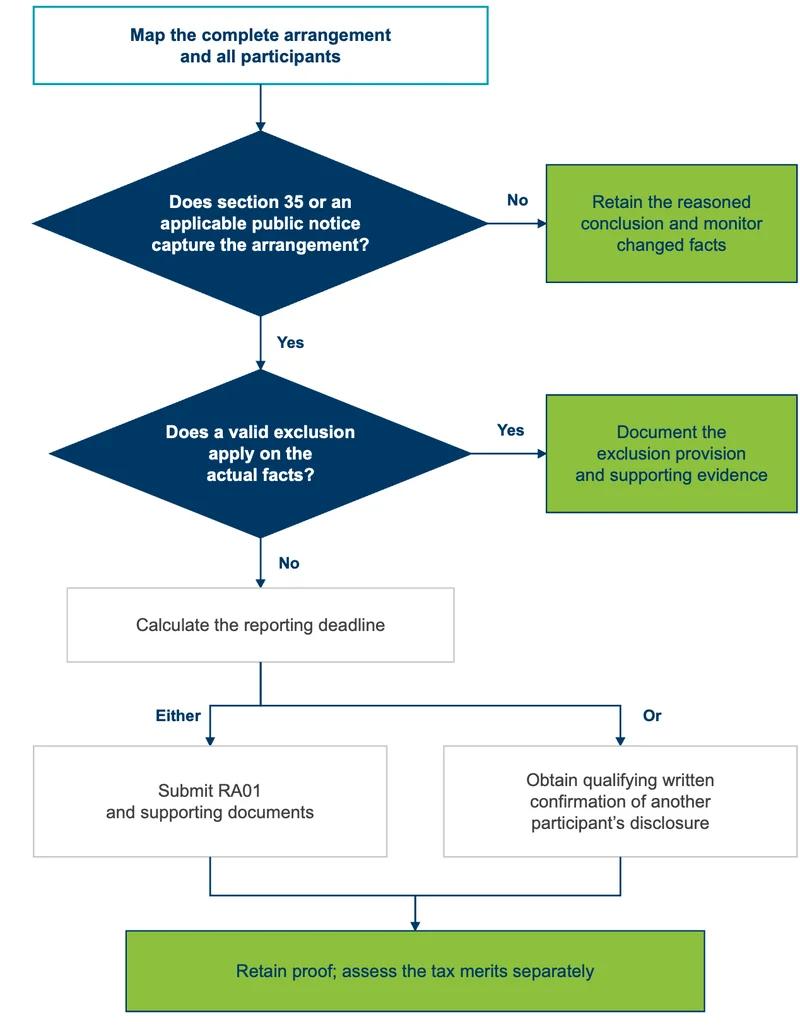
Practitioner action checklist
|
# |
Area |
Finding or requirement |
Clients affected |
Action required |
Deadline |
|
1 |
Screening |
Classification requires statutory matching. |
Clients undertaking structured transactions |
Record triggers, notices and exclusions. |
At transaction design |
|
2 |
Responsibility |
Multiple participants may have duties. |
Transaction participants and promoters |
Assign ownership and identify each role. |
Before implementation |
|
3 |
Timing |
Reporting is independent of annual returns. |
Participants in reportable arrangements |
Calculate and diary the 45-business-day period. |
From the applicable trigger |
|
4 |
Evidence |
Disclosure requires substantive supporting material. |
Reporting clients |
Reconcile RA01, agreements and tax model. |
Before submission |
|
5 |
Reliance |
Another party’s disclosure needs written confirmation. |
Clients relying on a promoter or participant |
Obtain and retain the statement and reference. |
Before relying on the exception |
Related reading: Voluntary disclosure: eligibility, voluntariness and relief are different questions; Paying a connected company’s costs: when the deduction belongs nowhere on your return; Determining the tax consequences of director loan accounts.
Official source: Tax Administration Act 28 of 2011 (South African Government).
Frequently asked questions
When must a reportable arrangement be disclosed to SARS?
Generally within 45 business days, and a further 45 may be allowed on reasonable grounds. Identify the trigger and diarise the deadline separately from the tax return.
Is a lawful structure exempt from reportable arrangement rules?
No. An arrangement may require disclosure even where the participant considers its tax treatment defensible. Test section 35, the applicable public notices and the section 36 exclusions.
Who must report a reportable arrangement?
Participants and any promoter. A client deriving a benefit should not assume the obligation rests only with the firm that designed the structure.
What penalties apply for not reporting an arrangement?
Monthly amounts apply, differing for promoters and other participants, with escalation for larger tax benefits. Quantify exposure as soon as an omission is discovered.
Stay current: for ongoing monthly updates on developments like this, explore The Tax Faculty’s CPD subscription plans.
About the author
Dr Stiaan Klue is Executive Dean and CEO of The Tax Faculty. He was the founding CEO of the South African Institute of Taxation (SAIT) and is the founding author of Silke on Tax Administration (LexisNexis).