




CATEGORIES
- (3)AI & Technology
- (52)Accounting & Financial Reporting
- (1)Accounting for Income Tax
- (1)Assessed losses
- (38)Blogs
- (4)Business Advisory
- (8)Capital Gains Tax
- (1)Capital Gains Tax - Individuals Tax
- (1)Capital Gains Tax Implications of Trusts
- (2)Case study: Home office expense
- (1)Case study: Travel allowances
- (1)Company Formations
- (10)Compliance
- (141)Corporate Tax
- (15)Customs and Excise
- (2)Deceased Estate
- (1)Deductions Pre-trade and prepaid expenses
- (1)Deregistration
- (2)Employer and Employee (PAYE and UIF Specific)
- (1)Estate Duty
- (1)Events / Webinars
- (11)Faculty News
- (2)Farming
- (177)Individuals Tax
- (1)Input - Customs Duty
- (3)Interest
- (23)International Tax
- (1)Nature of the rights of beneficiaries
- (1)Notional input tax
- (10)Payroll
- (1)People & Practice Management
- (2)Practical Payroll
- (1)Professional Ethics
- (2)Provisional tax (Link with other Taxes)
- (4)SARS Issues
- (178)Tax Administration
- (2)Tax Administration Part 2B: Resolving Problems with SARS using the Tax Ombud
- (1)Tax Administration Part 3B Dispute Resolution - Objection and appeal
- (8)Tax Dispute Resolution
- (1)Tax Opinions
- (3)Tax Update
- (1)Tax implications of loans to trusts
- (1)Tax residence
- (1)Tax returns and payments
- (3)Transfer-Pricing
- (1)Trust Income / Gain Allocations
- (1)Trust types and income allocations
- (12)Trusts
- (88)VAT
- (3)VAT periods
- (1)Wear and tear allowances
- (14)Wills, Estates & Succession
- (1)Zero Rated
- (2)eFiling
- Show All

Protecting dispute deadlines while pursuing SARS complaints
- 28 October 2026
- Tax Dispute Resolution
- Dr Stiaan Klue
Source: TaxCafe, Carmen Westermeyer CA(SA), October 2026. Available on Webinar-on-Demand: TaxCafe with Carmen Westermeyer - October 2026
At a glance
|
Step |
General period or route |
Important qualification |
|
Request reasons under rule 6 |
Within 30 business days of assessment |
Prescribed request; extensions have conditions |
|
SARS provides reasons |
Generally 45 business days after request |
Adequate-reasons notice and extensions differ |
|
Objection under rule 7 |
Within 80 business days |
Trigger depends on a valid reasons request |
|
Appeal under rule 10 |
Within 30 business days of objection outcome |
Apply the rules and extension provisions |
|
Service complaint |
SARS complaints process; then Tax Ombud where appropriate |
Does not replace a merits dispute |
A practitioner can spend weeks pursuing a service complaint while an assessment becomes final. The risk arises because an unanswered query feels like an unresolved tax dispute, even though the prescribed objection or appeal has never been delivered.
Delayed reasons, repeated information requests and collection action may require more than one response. Assign each issue to the appropriate process and record its deadline. An escalation through SARS, a recognised controlling body or the Tax Ombud must be coordinated with any prescribed tax remedy.
Classify the problem before escalating it
The South African Revenue Service (SARS) complaints process addresses dissatisfaction with service or administration. Incorrect assessments and objectionable decisions require the prescribed dispute process. A request for remission may be the relevant first step for particular penalties, while a correction mechanism may suit an obvious return error. These routes should not be treated as interchangeable. SARS: lodge a complaint.
The Tax Administration Act 28 of 2011 and rules issued under section 103 govern the relevant objections and appeals. Identify the actual notice, date of assessment or decision, grounds of dissatisfaction and relief sought. A generic email stating that the client disagrees may not constitute a valid objection.
A recognised controlling body can assist with practitioner escalation or systemic concerns. That assistance is valuable, but it is not a statutory appeal tribunal and does not automatically stop a time period. Record exactly what has been referred and who remains responsible for the prescribed remedy.
Client conversation trigger: For every unresolved SARS matter, classify it as service, correction, remission, reasons, objection, appeal or collection relief, and assign a responsible person to each active route.
Diarise reasons and objection with the correct trigger
A rule 6 request seeks the reasons needed to formulate an objection. The ordinary request period is 30 business days from the assessment. SARS generally has 45 business days to provide reasons, subject to the rules on adequate reasons already supplied and permitted extensions. An informal request for an explanation should not simply be assumed to have the same procedural effect.
Rule 7 ordinarily allows 80 business days for objection. Where reasons were properly requested, the relevant trigger is delivery of the notice that adequate reasons have already been provided or delivery of the requested reasons, as the rules specify. Without such a request, the assessment date is the ordinary starting point. SARS: objections; Dispute Resolution Guide, rules 6, 7 and 10.
Count business days under the applicable statutory and rule definitions, including the relevant year-end exclusion. Record the calculation and any extension in writing. A condonation application is a remedy subject to conditions, not a substitute for an accurate diary.
Where SARS defaults, consider the procedure available at that particular stage, including an appropriate rule 56 process where applicable. The correct forum and prerequisites must be established. Do not assume that every delay automatically produces a default judgment in the taxpayer’s favour.
Client conversation trigger: Audit open reasons requests against the underlying assessment dates and prescribed submissions, especially where the file contains only call-centre references or ordinary emails.
Escalate service failures with a concise chronology
An effective complaint identifies the original case, what SARS was asked to do, the relevant dates, previous attempts, the present prejudice and the specific outcome required. Attach the necessary evidence and submission receipts. Repetition without a chronology makes it harder to distinguish an unresolved case from a new enquiry.
The Office of the Tax Ombud generally requires exhaustion of SARS’s available internal complaints mechanisms unless compelling circumstances justify otherwise. Its mandate concerns service, procedural and administrative issues; it does not replace the tax court’s determination of the merits of an assessment. Its published process should guide the referral. Tax Ombud: submitting a complaint.
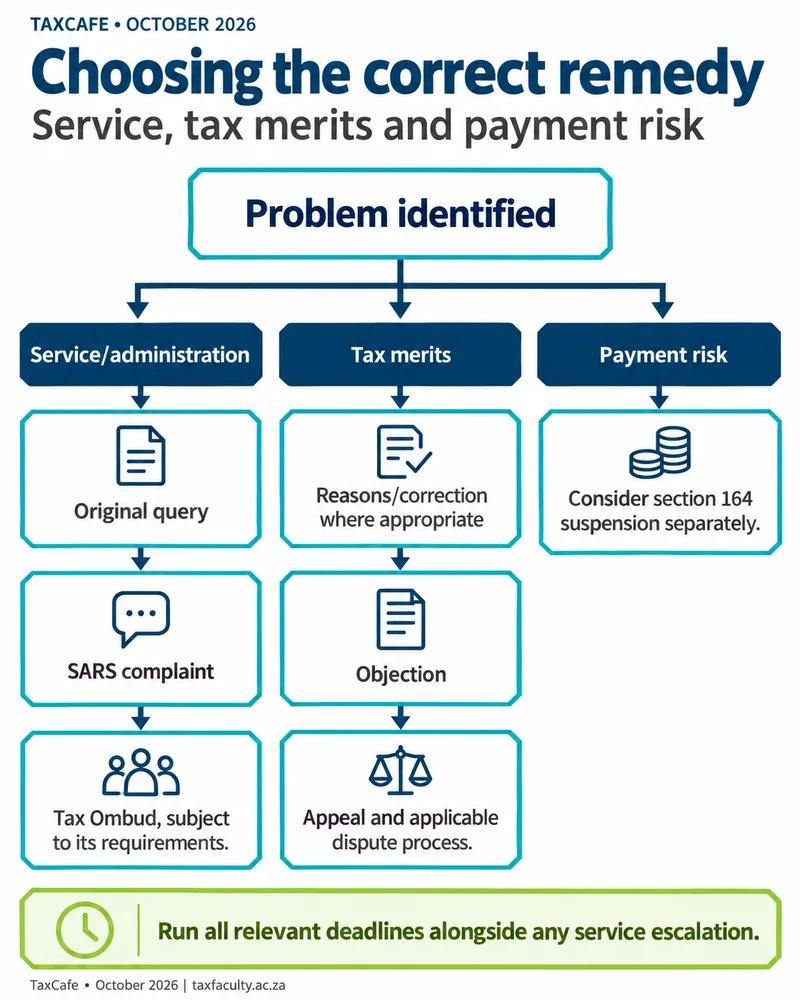
An objection does not ordinarily suspend the obligation to pay. Section 164 addresses suspension of payment and must be considered separately where collection exposure exists. The complaint file should therefore state whether payment is due, whether suspension has been requested and what SARS has decided.
Client conversation trigger: Where delay is causing collection or refund prejudice, include the financial impact in the complaint and separately assess payment-suspension or other legal relief.
Practitioner action checklist
|
# |
Area |
Issue |
Clients affected |
Action required |
Timing |
|
1 |
Classification |
Wrong procedural route |
Unresolved matters |
Identify decision and remedy |
On receipt |
|
2 |
Reasons |
Informal versus prescribed request |
Unexplained assessments |
Check rule 6 compliance |
Within applicable period |
|
3 |
Diary |
Objection and appeal |
Disputing taxpayers |
Calculate and record deadlines |
Immediately |
|
4 |
Complaint |
Incomplete chronology |
Delayed cases |
Submit concise evidence bundle |
After normal process |
|
5 |
Payment |
Dispute does not suspend debt |
Collection exposure |
Consider section 164 |
Before enforcement |
Keep the complaints chronology and the dispute diary current together. For each matter, record the next required step, its deadline and whether a separate payment-suspension response is needed.
Related reading: Responding to verification requests and identifying audit; Estimated assessments: challenge the calculation and prove the alternative; Challenging restrictions on tax refunds and bank accounts.
Frequently asked questions
Does lodging a SARS complaint extend the objection deadline?
No. A practitioner can pursue a service complaint while an assessment becomes final, because the prescribed objection or appeal was never delivered. Each issue needs its own process and deadline.
When should I use the SARS complaints process instead of an objection?
The complaints process addresses dissatisfaction with service or administration. Incorrect assessments and objectionable decisions require the prescribed dispute process.
Is an email saying I disagree a valid objection?
It may not be. Identify the notice, date of assessment or decision, grounds of dissatisfaction and relief sought under the Tax Administration Act and the dispute rules.
Build your expertise: to apply these principles in practice, explore The Tax Faculty’s SARS Service Failures: Practical Strategies for Effective Complaints and Escalation to the Tax Ombud webinar on demand.
About the author
Dr Stiaan Klue is Executive Dean and CEO of The Tax Faculty. He was the founding CEO of the South African Institute of Taxation (SAIT) and is the founding author of Silke on Tax Administration (LexisNexis).