




CATEGORIES
- (3)AI & Technology
- (52)Accounting & Financial Reporting
- (1)Accounting for Income Tax
- (1)Assessed losses
- (38)Blogs
- (4)Business Advisory
- (8)Capital Gains Tax
- (1)Capital Gains Tax - Individuals Tax
- (1)Capital Gains Tax Implications of Trusts
- (2)Case study: Home office expense
- (1)Case study: Travel allowances
- (1)Company Formations
- (10)Compliance
- (141)Corporate Tax
- (15)Customs and Excise
- (2)Deceased Estate
- (1)Deductions Pre-trade and prepaid expenses
- (1)Deregistration
- (2)Employer and Employee (PAYE and UIF Specific)
- (1)Estate Duty
- (1)Events / Webinars
- (11)Faculty News
- (2)Farming
- (177)Individuals Tax
- (1)Input - Customs Duty
- (3)Interest
- (23)International Tax
- (1)Nature of the rights of beneficiaries
- (1)Notional input tax
- (10)Payroll
- (1)People & Practice Management
- (2)Practical Payroll
- (1)Professional Ethics
- (2)Provisional tax (Link with other Taxes)
- (4)SARS Issues
- (178)Tax Administration
- (2)Tax Administration Part 2B: Resolving Problems with SARS using the Tax Ombud
- (1)Tax Administration Part 3B Dispute Resolution - Objection and appeal
- (8)Tax Dispute Resolution
- (1)Tax Opinions
- (3)Tax Update
- (1)Tax implications of loans to trusts
- (1)Tax residence
- (1)Tax returns and payments
- (3)Transfer-Pricing
- (1)Trust Income / Gain Allocations
- (1)Trust types and income allocations
- (12)Trusts
- (88)VAT
- (3)VAT periods
- (1)Wear and tear allowances
- (14)Wills, Estates & Succession
- (1)Zero Rated
- (2)eFiling
- Show All

Completing payroll deregistration for each tax type
- 28 October 2026
- Compliance
- Dr Stiaan Klue
Source: TaxCafe, Carmen Westermeyer CA(SA), October 2026. Available on Webinar-on-Demand: TaxCafe with Carmen Westermeyer - October 2026
At a glance
|
Registration |
Closing enquiry |
Evidence of completion |
|
PAYE |
Employer has ceased the relevant liability |
Final reconciliation and cancellation outcome |
|
UIF |
Contribution liability and collection channel |
Correct SARS or UIF status |
|
SDL |
Separate levy liability |
Tax-type cancellation or applicable status |
|
Income tax |
Ongoing taxpayer and filing position |
Separate SARS decision and resolved returns |
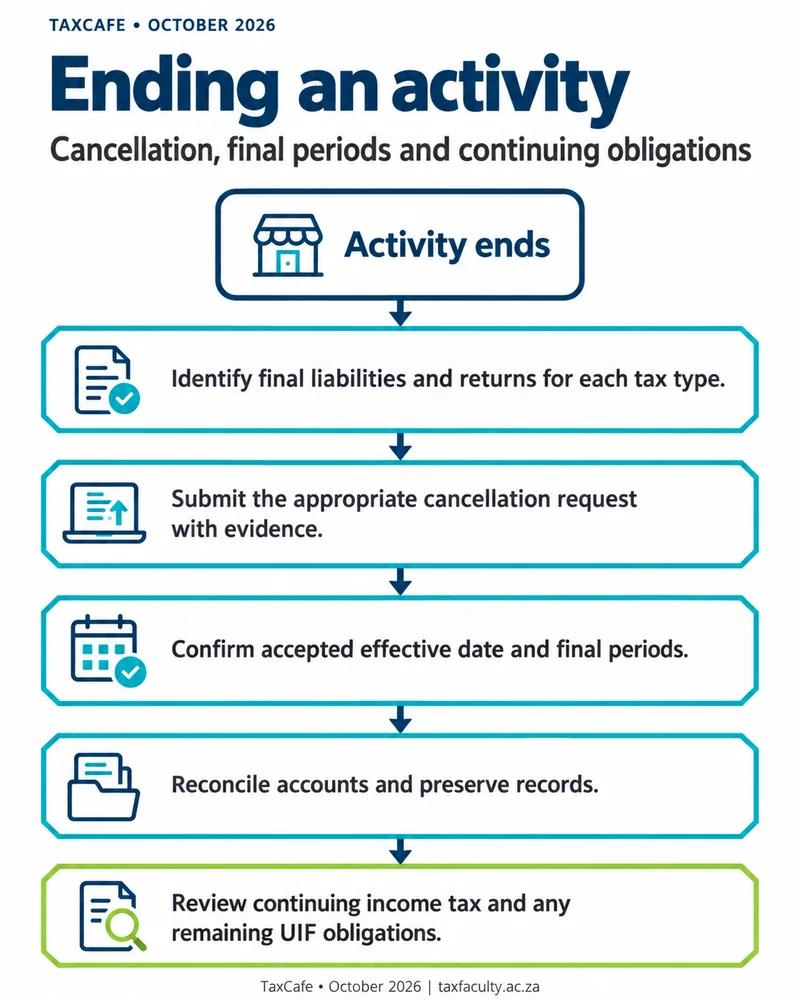
An employer’s final salary payment does not automatically close its payroll registrations. Nor does cancellation of one tax type necessarily cancel another. The closure process must identify the last liability, complete the final declarations and obtain confirmation of the effective deregistration date.
A closure review should cover employees’ tax collected through pay-as-you-earn (PAYE), unemployment-insurance contributions and skills development levies separately. It must also identify any continuing income-tax obligations. This prevents an apparently closed business from accumulating further outstanding returns or incorrect employee records.
Close employees tax with a complete final reconciliation
Employees’ tax obligations arise under the Fourth Schedule to the Income Tax Act 58 of 1962. Establish the final remuneration, including amounts paid after ordinary operations cease. Final leave pay, bonuses or termination-related amounts may require treatment even after the last normal payroll run.
The South African Revenue Service (SARS) identifies several PAYE cancellation routes: the final employer reconciliation declaration (EMP501) with a reason for deregistration, the eFiling deregistration function, or written notification with the relevant form. EMP123 concerns cancellation of all businesses; EMP123T concerns a separately registered branch or division. Use the channel appropriate to the case and retain proof. SARS: cancelling employees’ tax registration.
The requested date should be supported by payroll and operational records. A cancellation application is not proof that SARS has accepted that date. Check the outcome, the final return periods and the statement of account. Resolve payment allocations and outstanding reconciliations so that the closing balance is understood.
Client conversation trigger: For employers ceasing operations, prepare a final remuneration schedule before choosing the cancellation date and confirm that all employees receive correct certificates.
UIF and SDL require their own decisions
Unemployment Insurance Fund (UIF) contributions arise under the Unemployment Insurance Contributions Act 4 of 2002, while the Skills Development Levies Act 9 of 1999 governs the skills development levy (SDL). Their obligations should be reviewed separately from the amount of employees’ tax withheld.
SARS’s registration-maintenance guide provides for selecting PAYE, SDL or UIF separately, with an effective date and reason. That supports a deliberate tax-type review rather than an assumption that one request closes everything. SARS: RAV01 guide, payroll deregistration.
A business may cease to have a SARS payroll-registration requirement while still employing people and owing UIF contributions through the appropriate channel. SARS’s UIF guide expressly distinguishes registration with SARS from registration with the Unemployment Insurance Commissioner. Cancellation at SARS should not create a contribution gap. SARS: employer UIF guide.
Employee termination and contribution declarations should also be accurate. Closing the employer’s tax type is not a substitute for updating the employment information on which employees may later rely.
Client conversation trigger: Where employees remain after PAYE cancellation, confirm the continuing UIF obligation and collection channel before the next contribution becomes due.
Keep income tax closure and ongoing filing separate
A person with no employees may still earn taxable income. A company that stops trading may retain investments, dispose of assets or incur final tax liabilities. An individual who ceases one activity may retain employment, rental or investment income. PAYE deregistration therefore does not determine the income-tax position.
Similarly, being below a tax-payment threshold is not necessarily the same as being outside the annual return-filing requirements. Apply the relevant filing notice and the taxpayer’s circumstances. Provisional-tax status also follows its statutory definition; SARS states that there is no separate provisional-tax registration or deregistration process. SARS: provisional tax.
Keep the responsible representative and contact details current until outstanding matters are dealt with. A client should not lose access to notices simply because the payroll administrator has left or the business email address has been closed. The final engagement record should state which registrations are closed and which matters remain open.
Client conversation trigger: Give closing clients a tax-type completion schedule showing accepted dates, final returns, balances and any continuing obligations, rather than a general statement that they are “deregistered”.
Practitioner action checklist
|
# |
Area |
Issue |
Clients affected |
Action required |
Timing |
|
1 |
PAYE |
Final remuneration |
Closing employers |
Complete payroll and EMP501 |
On cessation |
|
2 |
UIF/SDL |
Separate liabilities |
Employers |
Review each tax type and channel |
Before cancellation |
|
3 |
Outcome |
Requested versus accepted date |
All applicants |
Retain SARS decision |
On response |
|
4 |
Income tax |
Continuing activity |
Businesses/individuals |
Review returns and provisional status |
Before closure |
|
5 |
Records |
Future correspondence |
Closing clients |
Preserve access and handover |
At completion |
Give the client a closure schedule listing accepted deregistration dates, final returns and any continuing obligations. Keep responsibility for unresolved matters explicit until the supporting confirmations arrive.
Related reading: Resolving payroll submission and reconciliation failures; Determining the tax consequences of director loan accounts; Moving the business does not necessarily leave the tax debt behind.
Frequently asked questions
Does cancelling PAYE also cancel UIF and SDL?
No. Cancellation of one tax type does not necessarily cancel another. Employees’ tax, unemployment-insurance contributions and skills development levies should be reviewed and closed separately.
How do I deregister for PAYE with SARS?
SARS identifies several routes: the final EMP501 reconciliation with a reason for deregistration, the eFiling deregistration function, or written notification with the relevant form. EMP123 concerns cancellation of all businesses and EMP123T a separately registered branch or division.
What should be included in the final payroll before deregistering?
Establish the final remuneration, including amounts paid after ordinary operations cease. Final leave pay, bonuses or termination-related amounts may require treatment after the last normal payroll run.
Build your expertise: to apply these principles in practice, explore The Tax Faculty’s Short Course in Payroll Taxes and Processing.
About the author
Dr Stiaan Klue is Executive Dean and CEO of The Tax Faculty. He was the founding CEO of the South African Institute of Taxation (SAIT) and is the founding author of Silke on Tax Administration (LexisNexis).