




CATEGORIES
- (3)AI & Technology
- (52)Accounting & Financial Reporting
- (1)Accounting for Income Tax
- (1)Assessed losses
- (38)Blogs
- (4)Business Advisory
- (8)Capital Gains Tax
- (1)Capital Gains Tax - Individuals Tax
- (1)Capital Gains Tax Implications of Trusts
- (2)Case study: Home office expense
- (1)Case study: Travel allowances
- (1)Company Formations
- (10)Compliance
- (141)Corporate Tax
- (15)Customs and Excise
- (2)Deceased Estate
- (1)Deductions Pre-trade and prepaid expenses
- (1)Deregistration
- (2)Employer and Employee (PAYE and UIF Specific)
- (1)Estate Duty
- (1)Events / Webinars
- (11)Faculty News
- (2)Farming
- (177)Individuals Tax
- (1)Input - Customs Duty
- (3)Interest
- (23)International Tax
- (1)Nature of the rights of beneficiaries
- (1)Notional input tax
- (10)Payroll
- (1)People & Practice Management
- (2)Practical Payroll
- (1)Professional Ethics
- (2)Provisional tax (Link with other Taxes)
- (4)SARS Issues
- (178)Tax Administration
- (2)Tax Administration Part 2B: Resolving Problems with SARS using the Tax Ombud
- (1)Tax Administration Part 3B Dispute Resolution - Objection and appeal
- (8)Tax Dispute Resolution
- (1)Tax Opinions
- (3)Tax Update
- (1)Tax implications of loans to trusts
- (1)Tax residence
- (1)Tax returns and payments
- (3)Transfer-Pricing
- (1)Trust Income / Gain Allocations
- (1)Trust types and income allocations
- (12)Trusts
- (88)VAT
- (3)VAT periods
- (1)Wear and tear allowances
- (14)Wills, Estates & Succession
- (1)Zero Rated
- (2)eFiling
- Show All

Testing the tax exemption for seafarers and yacht crew
- 28 October 2026
- International Tax
- Dr Stiaan Klue
Source: TaxCafe, Carmen Westermeyer CA(SA), October 2026. Available on Webinar-on-Demand: TaxCafe with Carmen Westermeyer - October 2026
At a glance
|
Requirement |
Section 10(1)(o)(i) enquiry |
|
Relationship |
Qualifying remuneration as an employed officer or crew member |
|
Vessel activity |
International transport for reward, or the specified offshore activities |
|
Offshore-activity branch |
Employment solely for the ship’s passage is a specific limitation |
|
Absence |
More than 183 full days outside the Republic in the year of assessment |
|
Evidence |
Contract, vessel activity, role and reliable day count |
Working aboard a vessel is not a complete answer to the South African tax enquiry. The activity of the ship, the worker’s legal relationship and the qualifying absence period must all be established. Private yacht employment is particularly vulnerable to assumptions based on the vessel’s international itinerary rather than its commercial activity.
The seafarer exemption has different requirements for international transport and specified offshore mineral activities. A reliable review identifies the applicable branch, checks the employment role and calculates full days of absence over the correct period. Each condition needs evidence for the year under review.
Identify the correct branch of the exemption
Section 10(1)(o)(i) of the Income Tax Act 58 of 1962 addresses qualifying remuneration of an officer or crew member. Under item (aa), the ship must be engaged in international transportation of passengers or goods for reward. Under item (bb), the specified prospecting, exploration, mining or production activities are addressed, with the employee required to be employed solely for the ship’s passage.
The “solely for passage” restriction should not be transferred indiscriminately from item (bb) into item (aa). A cruise-ship employee is not automatically excluded merely because the job involves hospitality rather than navigation. Equally, someone operating an independent concession aboard a ship is not necessarily an employee or crew member within the provision.
The South African Revenue Service (SARS) explains these distinctions in Interpretation Note No. 34 (Issue 2), particularly paragraphs 4.1 to 4.3. The ship’s business and the person’s actual capacity must be evidenced. Interpretation Note No. 34.
Client conversation trigger: Ask every maritime client for evidence of the vessel’s commercial activity and their employment role, rather than accepting “yacht crew” as a sufficient tax classification.
Count the days under the provision being claimed
The exemption requires absence from the Republic for periods exceeding 183 full days in aggregate during the year of assessment. That means at least 184 qualifying full days. The qualifying period differs from the general foreign-employment exemption under section 10(1)(o)(ii), which must be tested separately.
A travel schedule should distinguish arrival and departure days from full days and consider the statutory meaning of the Republic. The fact that a person was aboard a vessel does not necessarily mean the person was outside South Africa. Port records, voyage records, passport movements and the employer’s confirmation should be reconciled where they differ.
Illustrative example. An employed officer spends 185 full days outside the Republic during the year. That may satisfy the day component. If the vessel is a private recreational yacht that does not transport passengers or goods for reward and does not fall within the other qualifying branch, the day count alone does not establish exemption. Conversely, 180 full days would fail this particular day requirement even if the vessel’s activity qualifies.
Where the claimed exemption fails, consider any other legally available treatment on its own conditions. Section 10(1)(o)(ii) is not an automatic fallback, and section 10(1)(o)(iA), concerning qualifying South African ships, is a distinct provision that should not be conflated with the one considered here.
Client conversation trigger: Recalculate maritime day schedules by year of assessment and record which exemption is being tested, with its own qualifying-period rules.
Build a file that proves all the conditions together
A strong file connects the employment contract to the vessel, the vessel to its qualifying activity, and the remuneration to the services and period claimed. The employer’s letter should do more than confirm a job title. It should identify the vessel, employment period and nature of the operation, supported where necessary by commercial or voyage documentation.
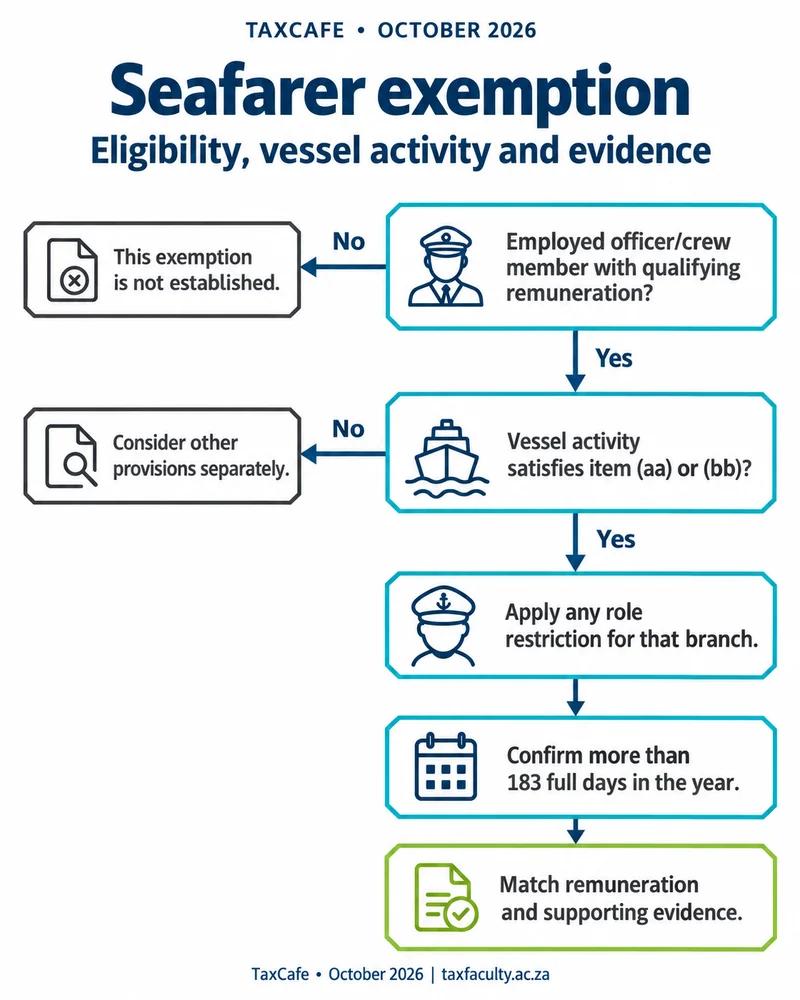
Residence remains relevant. A non-resident’s foreign-source employment income may fall outside South African gross income without needing the resident’s exemption analysis. A resident must instead identify the applicable inclusion and relief. A favourable result in one year should not simply be carried forward: the vessel, contract, activity and days can change.
Client conversation trigger: Before filing, obtain a signed annual factual confirmation covering residence, employer, vessel, role and absences, and compare it with independent records.
Practitioner action checklist
|
# |
Area |
Issue |
Clients affected |
Action required |
Timing |
|
1 |
Vessel |
Qualifying activity |
Yacht and ship workers |
Obtain operational evidence |
Each contract |
|
2 |
Role |
Employment and branch limitation |
Crew and contractors |
Test actual capacity |
Before exemption |
|
3 |
Days |
More than 183 full days |
Resident claimants |
Reconcile annual calendar |
Before filing |
|
4 |
Income |
Matching remuneration |
All claimants |
Tie earnings to services and period |
Annually |
Sign off the maritime exemption only after the contract, vessel activity and annual day count have been checked together. Repeat that review when the vessel, role or employment terms change.
Related reading: Distinguishing foreign employment from independent consulting; Protecting the tax position when foreign income fields change; Defining representative roles for nonresident clients.
Frequently asked questions
Are yacht crew exempt from South African tax?
Not automatically. The ship’s activity, the worker’s legal relationship and the qualifying absence period must be established, and private yacht work is vulnerable to assumptions based on the itinerary.
How many days outside South Africa do seafarers need?
More than 183 full days in aggregate during the year of assessment, which means at least 184 qualifying full days. Arrival and departure days are not full days.
Are cruise ship hospitality workers excluded from the exemption?
Not automatically. The solely for passage restriction belongs to the offshore activities branch and should not be transferred into the international transport branch.
Build your expertise: to apply these principles in practice, explore The Tax Faculty’s Short Course in International Tax.
About the author
Dr Stiaan Klue is Executive Dean and CEO of The Tax Faculty. He was the founding CEO of the South African Institute of Taxation (SAIT) and is the founding author of Silke on Tax Administration (LexisNexis).