




CATEGORIES
- (3)AI & Technology
- (52)Accounting & Financial Reporting
- (1)Accounting for Income Tax
- (1)Assessed losses
- (38)Blogs
- (4)Business Advisory
- (8)Capital Gains Tax
- (1)Capital Gains Tax - Individuals Tax
- (1)Capital Gains Tax Implications of Trusts
- (2)Case study: Home office expense
- (1)Case study: Travel allowances
- (1)Company Formations
- (10)Compliance
- (141)Corporate Tax
- (15)Customs and Excise
- (2)Deceased Estate
- (1)Deductions Pre-trade and prepaid expenses
- (1)Deregistration
- (2)Employer and Employee (PAYE and UIF Specific)
- (1)Estate Duty
- (1)Events / Webinars
- (11)Faculty News
- (2)Farming
- (177)Individuals Tax
- (1)Input - Customs Duty
- (3)Interest
- (23)International Tax
- (1)Nature of the rights of beneficiaries
- (1)Notional input tax
- (10)Payroll
- (1)People & Practice Management
- (2)Practical Payroll
- (1)Professional Ethics
- (2)Provisional tax (Link with other Taxes)
- (4)SARS Issues
- (178)Tax Administration
- (2)Tax Administration Part 2B: Resolving Problems with SARS using the Tax Ombud
- (1)Tax Administration Part 3B Dispute Resolution - Objection and appeal
- (8)Tax Dispute Resolution
- (1)Tax Opinions
- (3)Tax Update
- (1)Tax implications of loans to trusts
- (1)Tax residence
- (1)Tax returns and payments
- (3)Transfer-Pricing
- (1)Trust Income / Gain Allocations
- (1)Trust types and income allocations
- (12)Trusts
- (88)VAT
- (3)VAT periods
- (1)Wear and tear allowances
- (14)Wills, Estates & Succession
- (1)Zero Rated
- (2)eFiling
- Show All

Voluntary disclosure: eligibility, voluntariness and relief are different questions
- 27 October 2026
- Tax Administration
- Dr Stiaan Klue
Source: Monthly Tax Update, Professor Jackie Arendse, October 2026. Webinar-on-Demand: Monthly SARS Update with Prof Jackie Arendse - October 2026
At a glance
|
Question |
Required analysis |
Practice consequence |
|
Can the applicant apply? |
Section 226 eligibility, including relevant audit or investigation notification. |
Obtain the full SARS-contact history. |
|
Is the disclosure valid? |
All section 227 requirements, including voluntariness and material completeness. |
Absence of an audit notice is not the entire test. |
|
What relief follows? |
Statutory relief and a written agreement, with differing penalty outcomes. |
Do not promise a blanket amnesty. |
|
What remains payable? |
Underlying tax and interest generally remain. |
Prepare a funded calculation and payment proposal. |
|
Can relief be lost? |
Material non-disclosure can justify withdrawal. |
Reconcile the full default before submission. |
The voluntary disclosure programme (VDP) can provide substantial relief for historical tax defaults, but it is not a mechanism for obtaining automatic immunity whenever an amended calculation is submitted. The South African Revenue Service’s (SARS) Issue 2 guide separates eligibility, the validity of the disclosure and the relief ultimately granted. A sound advice file should do the same.
The guide was issued on 21 May 2026 and is an opportunity for practitioners to revisit procedures, particularly where an accountant discovers undeclared income, incorrect VAT treatment or other historical defaults during ordinary compliance work.
Establish eligibility from the actual correspondence
Section 226 regulates who may qualify. Notification of an unconcluded audit or criminal investigation related to the disclosed default creates an obstacle. The legislation also permits a senior SARS official to allow relief in the specified circumstances where the default would not otherwise have been detected and admission would serve good tax administration and use of resources.
That exception is a reasoned statutory discretion, not an automatic entitlement. A request should address the scope of the existing enquiry, why the particular default would fall outside detection and the grounds on which the discretion should be exercised. Notifications to representatives and other specified connected persons can also matter; the client’s assertion that the principal taxpayer never personally read a notice is not enough.
A verification or inspection is not necessarily an audit for this purpose. Nevertheless, the guide emphasises that an applicant who clears the section 226 hurdle must still meet section 227. The accountant should therefore obtain notices, emails, calls recorded in attendance notes and prior responses, rather than classify the case by the subject line of the most recent SARS letter.
Client conversation trigger: Before recommending VDP, request a complete chronology of SARS contact involving the default, including contact through representatives, directors or trustees.
Voluntariness requires a separate factual enquiry
Section 227 requires a voluntary disclosure. It also requires material completeness, the relevant statutory behaviour, compliance with the prescribed form and manner, no resulting refund and satisfaction of the rule concerning a similar default disclosed within five years. Each requirement must be considered; compliance with one does not cure failure of another.
In Purveyors South Africa Mine Services (Pty) Ltd v Commissioner for the South African Revenue Service, the taxpayer had engaged SARS about import VAT on an aircraft, was advised that the tax should have been paid and was warned about penalties. Its later VDP application failed the voluntariness requirement in that factual setting. The guide uses the case to explain why the absence of a formal audit notice is not decisive.
The lesson should not be reduced to the proposition that wishing to avoid penalties always defeats VDP. Relief from penalties is part of the programme’s design. The concern is whether the disclosure is genuinely voluntary in the relevant legal sense, including what SARS already knew and what prompted the application. A practitioner should preserve the discovery chronology and address the actual default, rather than use a standard declaration divorced from the facts.
Client conversation trigger: Where a client seeks VDP after a SARS query, analyse the query’s content and its connection to the proposed disclosure before representing the application as voluntary.
Full disclosure starts with a defensible reconstruction
A VDP file should identify the tax types, periods, transactions, amounts and behaviour involved. The accountant’s core task is to reconstruct the correct position and show how it differs from the original returns or failures to file. Unexplained assumptions should be identified and resolved; omitting a related period or material step can undermine the application and later relief.
The calculation should be reproducible from source records. For omitted sales, that may require reconciling invoices, bank receipts, cash records and VAT periods. For an incorrect deduction, it may require tracing the expenditure, the original treatment and the proposed adjustment. The reconstruction should also identify amounts already assessed or paid so that the application does not duplicate liabilities.
Where eligibility remains uncertain, section 228 permits a non-binding private opinion on sufficient facts, without necessarily identifying the parties. The guide explains the limits of that route. It can assist preliminary analysis but does not bind SARS or replace a complete application.
Client conversation trigger: For a newly discovered default, agree a reconstruction scope covering all affected periods and tax types before submitting a partial account of the problem.
Quantify relief accurately
VDP relief depends on a valid disclosure and a written agreement. It includes non-pursuit of criminal prosecution for a tax offence arising from the covered default, understatement-penalty relief according to the statutory table, and specified administrative-penalty relief. It does not amount to immunity for every possible offence or a waiver of the underlying tax and interest.
The guide reproduces these understatement-penalty percentages:
|
Behaviour |
Qualifying disclosure before notification |
Qualifying disclosure after notification, where discretion permits |
|
Substantial understatement |
0% |
5% |
|
Reasonable care not taken |
0% |
15% |
|
No reasonable grounds for tax position |
0% |
25% |
|
Impermissible avoidance arrangement |
0% |
35% |
|
Gross negligence |
5% |
50% |
|
Intentional tax evasion |
10% |
75% |
The percentages apply to the statutory penalty base, not automatically to gross undeclared receipts. The timing categories also presuppose qualification; an applicant cannot buy eligibility by selecting the higher column. The guide states that administrative-penalty relief excludes penalties for late submission of a return. It would therefore be wrong to promise that every existing penalty will disappear.
An editorial illustration: if the relevant penalty base is R200,000 and a qualifying pre-notification disclosure falls in the gross-negligence category, a 5% understatement penalty is R10,000. The tax, interest and any excluded penalties must still be separately quantified. The example assumes the classification and eligibility; it does not determine either.
Client conversation trigger: Give clients a written relief schedule distinguishing underlying tax, interest, understatement penalties, other penalties and prosecution relief before they approve a VDP submission.
Treat the agreement and subsequent compliance seriously
The written agreement records the default, relief and payment arrangements. A client needs both an accurate liability computation and a realistic means of complying with the agreed terms. The programme should not be represented as a temporary holding measure that automatically suspends unrelated verification or future compliance duties.
Material non-disclosure discovered after agreement can lead to withdrawal of relief under section 231, treatment of payments as part payment of further debt and pursuit of criminal prosecution. The guide also distinguishes the available remedies concerning withdrawal from the bar on objecting to an assessment that gives effect to the agreed disclosure.
The strongest safeguard is therefore the quality of the original reconstruction and review. Keep the signed application, supporting schedules, agreement, payment proof and a record of corrective controls. Correcting the original cause, such as an omitted revenue stream or misconfigured VAT code, belongs in the engagement as well.
Client conversation trigger: Before finalising the agreement, have a reviewer reconcile the disclosed facts and calculations to the underlying records and confirm how recurrence will be prevented.
A VDP decision path
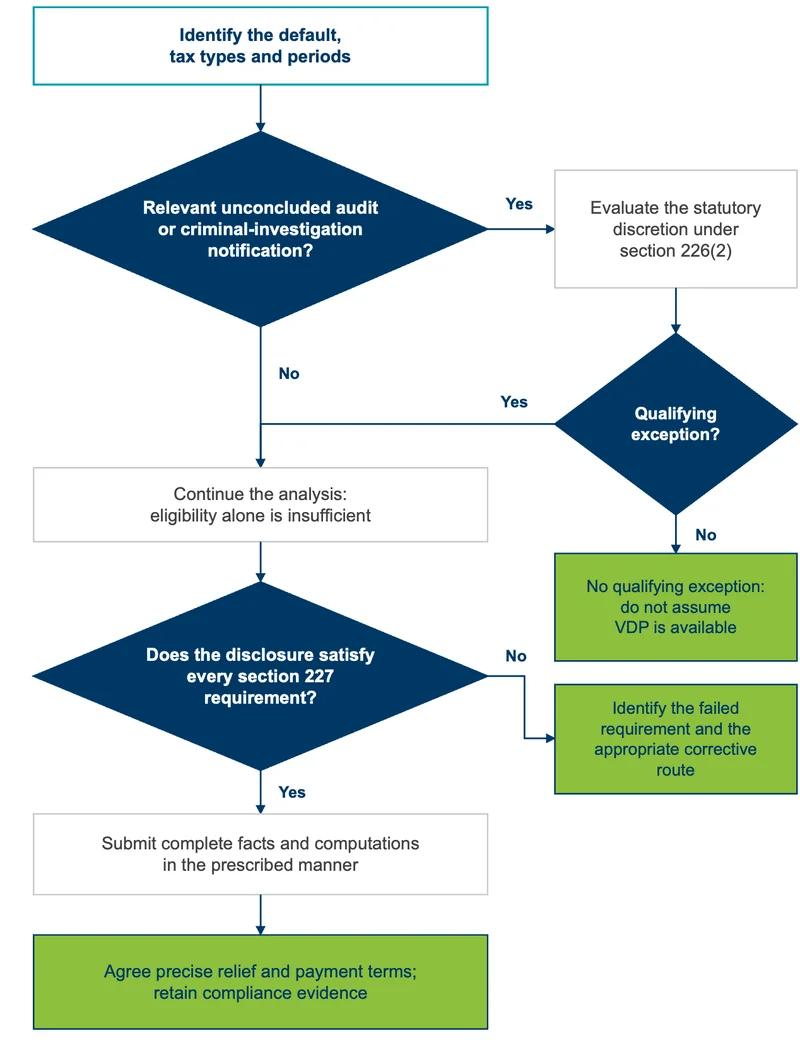
Practitioner action checklist
|
# |
Area |
Finding or requirement |
Clients affected |
Action required |
Deadline |
|
1 |
Eligibility |
Audit/investigation history matters. |
Clients with historical defaults |
Obtain all notices and representative correspondence. |
Before choosing VDP |
|
2 |
Voluntariness |
Section 227 remains a separate test. |
Clients already contacted by SARS |
Record discovery and contact chronology. |
Before application |
|
3 |
Completeness |
All material facts must be disclosed. |
Applicants |
Reconstruct all affected taxes and periods. |
Before submission |
|
4 |
Relief |
Penalties and other liabilities differ. |
Applicants |
Prepare a costed relief and payment schedule. |
Before client approval |
|
5 |
Agreement |
Relief depends on truthful disclosure and agreed terms. |
Successful applicants |
Retain agreement, implement payments and correct controls. |
Under the agreement |
Related reading: Reportable arrangements: put the disclosure decision into the transaction file; Auto-assessments: who actually has until 22 January 2027?; Estimated assessments: challenge the calculation and prove the alternative.
Official source: SARS: Voluntary Disclosure Programme.
Frequently asked questions
Can I apply for VDP if SARS has notified me of an audit?
Notification of an unconcluded audit or criminal investigation related to the default is an obstacle under section 226. A senior SARS official may allow relief in specified circumstances, but that is a discretion, not an entitlement.
What does section 227 require for a valid voluntary disclosure?
It must be voluntary and materially complete, involve the relevant behaviour, follow the prescribed form, not result in a refund and satisfy the rule on similar defaults within five years.
Is a SARS verification the same as an audit for VDP?
Not necessarily, but an applicant who clears the section 226 hurdle must still meet section 227. Obtain the full chronology of SARS contact rather than relying on the latest letter’s subject line.
Stay current: for ongoing monthly updates on developments like this, explore The Tax Faculty’s CPD subscription plans.
About the author
Dr Stiaan Klue is Executive Dean and CEO of The Tax Faculty. He was the founding CEO of the South African Institute of Taxation (SAIT) and is the founding author of Silke on Tax Administration (LexisNexis).