




CATEGORIES
- (3)AI & Technology
- (52)Accounting & Financial Reporting
- (1)Accounting for Income Tax
- (1)Assessed losses
- (38)Blogs
- (4)Business Advisory
- (8)Capital Gains Tax
- (1)Capital Gains Tax - Individuals Tax
- (1)Capital Gains Tax Implications of Trusts
- (2)Case study: Home office expense
- (1)Case study: Travel allowances
- (1)Company Formations
- (10)Compliance
- (141)Corporate Tax
- (15)Customs and Excise
- (2)Deceased Estate
- (1)Deductions Pre-trade and prepaid expenses
- (1)Deregistration
- (2)Employer and Employee (PAYE and UIF Specific)
- (1)Estate Duty
- (1)Events / Webinars
- (11)Faculty News
- (2)Farming
- (177)Individuals Tax
- (1)Input - Customs Duty
- (3)Interest
- (23)International Tax
- (1)Nature of the rights of beneficiaries
- (1)Notional input tax
- (10)Payroll
- (1)People & Practice Management
- (2)Practical Payroll
- (1)Professional Ethics
- (2)Provisional tax (Link with other Taxes)
- (4)SARS Issues
- (178)Tax Administration
- (2)Tax Administration Part 2B: Resolving Problems with SARS using the Tax Ombud
- (1)Tax Administration Part 3B Dispute Resolution - Objection and appeal
- (8)Tax Dispute Resolution
- (1)Tax Opinions
- (3)Tax Update
- (1)Tax implications of loans to trusts
- (1)Tax residence
- (1)Tax returns and payments
- (3)Transfer-Pricing
- (1)Trust Income / Gain Allocations
- (1)Trust types and income allocations
- (12)Trusts
- (88)VAT
- (3)VAT periods
- (1)Wear and tear allowances
- (14)Wills, Estates & Succession
- (1)Zero Rated
- (2)eFiling
- Show All

Repairs, improvements and recoveries: build the deduction from the work performed
- 27 October 2026
- Corporate Tax
- Dr Stiaan Klue
Source: Monthly Tax Update, Professor Jackie Arendse, October 2026. Webinar-on-Demand: Monthly SARS Update with Prof Jackie Arendse - October 2026
At a glance
|
Question |
Governing distinction |
File evidence |
|
Repair or improvement? |
Restoration of subsidiary parts differs from reconstruction of the entirety or creation of an improved asset. |
Before-and-after condition, scope and contractor breakdown. |
|
Modern materials? |
Using better contemporary materials does not automatically make work an improvement. |
Function and extent of the work. |
|
Mixed project? |
Separately identifiable repairs may qualify; integrated reconstruction cannot be artificially split. |
Genuine separability and reliable costing. |
|
Recovery? |
Insurance or other recovery may affect deduction or recoupment. |
Claims, entitlements, receipts and prior deductions. |
|
Software? |
Section 11(d) is not the general route for intangible software expenditure. |
Separate revenue/capital analysis under the relevant provisions. |
The description “repairs and maintenance” in a ledger is a starting point, not a tax conclusion. Issue 4 of the South African Revenue Service’s (SARS) Interpretation Note 74 provides a useful framework for distinguishing restoration from improvement and for dealing with later recoveries. It should guide evidence gathering; it does not replace section 11(d) or bind a court as legislation.
For tax accountants, the decisive task is to identify what was repaired, what condition required attention and what the work achieved. A contractor’s single-line invoice often supplies none of that information.
Identify the asset and the work, not merely the invoice label
Section 11(d) addresses expenditure actually incurred during the year on qualifying repairs to property occupied for trade or in respect of which income is receivable, and to machinery, implements, utensils and other articles employed for trade. The provision also expressly addresses specified beetle treatment of timber.
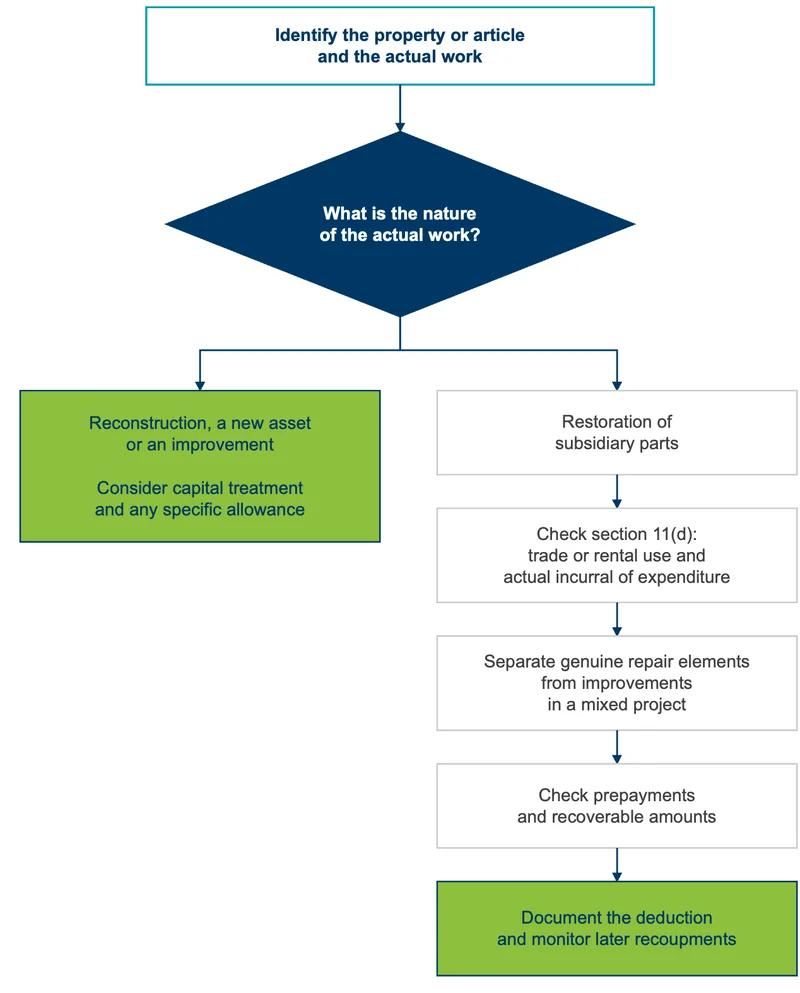
The repair enquiry generally concerns restoration through renewal or replacement of subsidiary parts of the whole. Reconstruction of the entirety is different. Identifying the relevant whole is therefore essential: the whole is not automatically the taxpayer’s entire business, nor is every replaced component necessarily a separate asset. The physical and functional facts determine the appropriate unit of analysis.
The spoken formulation suggesting replacement of “the whole” should not be carried into a tax policy. The note distinguishes repair of subsidiary parts from reconstruction of the entirety. Similarly, calling a project maintenance does not settle its character. Routine revenue expenditure may require analysis under section 11(a) and section 23(g), while qualifying repairs fall within the specific provision.
Client conversation trigger: Before approving a material repair deduction, obtain photographs, the original defect report and a description of the asset’s function before and after the work.
Modern materials and mixed projects require judgment
Using current materials or construction methods does not automatically create an improvement. An old component may be unavailable, or its modern equivalent may perform the same function more effectively. The relevant enquiry remains the nature and extent of the restoration and whether the project creates a different or improved asset in substance.
A mixed project requires greater discipline. Genuine repairs undertaken alongside an improvement may be separately deductible where they can be identified and reliably costed. But a single reconstruction project cannot be turned into deductible repairs merely by assigning a percentage of its price to work that resembles repair activity when viewed in isolation.
Consider an editorial example. A landlord incurs R120,000 restoring a damaged roof to its previous function and R180,000 on a separately designed extension. Assume the two projects are genuinely separable, the property meets the trade or rental requirements, the repair cost was incurred in the year, and there is no recoverable insurance amount or timing restriction. The R120,000 may qualify under section 11(d); the extension does not become a repair merely because the same contractor did both jobs. No immediate deduction for the R180,000 is assumed. Any capital allowance requires separate testing.
The accountant should ask for the breakdown before work begins where possible. A contemporaneous schedule of labour, materials and project components is more persuasive than an allocation created solely to support the tax return.
Client conversation trigger: For renovations combining restoration and expansion, agree a documented project breakdown with the client and contractor before invoices are consolidated.
Trade, timing and software remain separate tests
A repair classification does not complete the deduction enquiry. The property’s use or the rental income receivable, the year of actual incurral and any relevant prepayment restriction still matter. An invoice paid in advance should not simply be deducted because cash left the account; section 23H may need consideration.
The note’s treatment of software is also useful for contemporary businesses. Section 11(d) is not a general deduction for repairing an intangible. Software support or maintenance expenditure may require consideration under the general deduction formula, while creation, replacement or substantial enhancement can raise capital questions. The contract’s deliverables matter more than whether the supplier calls the invoice “maintenance”.
For a cloud-based arrangement, distinguish recurring access and support from implementation, development, migration and functionality changes. That classification is an editorial working-paper recommendation, not an assertion that every cloud cost has a prescribed treatment in the note. Record the service, period, rights obtained and expected benefit before selecting a tax provision.
Client conversation trigger: Review large property prepayments and bundled software invoices separately from routine maintenance accounts before year-end deductions are finalised.
Insurance and later recoveries can change the result
Section 23(c) restricts deductions for expenditure recoverable under insurance, guarantee, security or indemnity. The review should therefore identify entitlement to recovery, rather than wait only for the bank receipt. Where an amount previously deducted is subsequently recovered or recouped, section 8(4)(a) may require inclusion.
A later sale of the repaired property does not automatically recoup all historical repair deductions merely because a profit is made. The note explains the need to establish the relevant connection between the recovery and the expenditure previously allowed. The treatment of the sale itself remains a separate tax enquiry.
The practical control is a recovery register linking repair claims to insurance files and later receipts. Without it, one team may deduct the invoice while another posts the reimbursement without considering the previous tax treatment. The register should also record rejected claims and the dates on which the facts changed.
Client conversation trigger: For clients with insurance claims or indemnities, reconcile all repair deductions to recovery entitlements and subsequent settlements before signing the tax computation.
A working decision path
Practitioner action checklist
|
# |
Area |
Finding or requirement |
Clients affected |
Action required |
Deadline |
|
1 |
Classification |
Labels do not establish repairs. |
Businesses and landlords |
Keep defect reports, photographs and scope. |
Before work and on completion |
|
2 |
Mixed work |
Genuine separation requires evidence. |
Renovating clients |
Obtain itemised project costs. |
Before final billing |
|
3 |
Timing |
Incurral and prepayment rules matter. |
Clients prepaying work |
Review contractual liability and section 23H. |
Before return sign-off |
|
4 |
Software |
Intangibles need a separate analysis. |
Software users |
Split support, access, development and enhancement. |
At contract review |
|
5 |
Recovery |
Deduction and recoupment may be affected. |
Insured businesses and landlords |
Reconcile claims and receipts to prior deductions. |
Each reporting period |
Related reading: Paying a connected company’s costs: when the deduction belongs nowhere on your return; Determining the tax consequences of director loan accounts; Testing deductions and losses on family rentals.
Official source: Income Tax Act 58 of 1962 (South African Government).
Frequently asked questions
What is the difference between a repair and an improvement for tax?
Repair generally restores through renewal or replacement of subsidiary parts of the whole. Reconstruction of the entirety, or creation of an improved asset, is different.
Does using modern materials make a repair an improvement?
Not automatically. An old component may be unavailable, or its modern equivalent may perform the same function more effectively.
Do insurance payouts affect a repair deduction?
Yes. Insurance or other recoveries may affect the deduction or create a recoupment, so reconcile repair deductions to recovery entitlements before signing the computation.
Build your expertise: to apply these principles in practice, explore The Tax Faculty’s Short Course in the Fundamentals of Corporate Income Tax.
About the author
Dr Stiaan Klue is Executive Dean and CEO of The Tax Faculty. He was the founding CEO of the South African Institute of Taxation (SAIT) and is the founding author of Silke on Tax Administration (LexisNexis).