




CATEGORIES
- (3)AI & Technology
- (52)Accounting & Financial Reporting
- (1)Accounting for Income Tax
- (1)Assessed losses
- (38)Blogs
- (4)Business Advisory
- (8)Capital Gains Tax
- (1)Capital Gains Tax - Individuals Tax
- (1)Capital Gains Tax Implications of Trusts
- (2)Case study: Home office expense
- (1)Case study: Travel allowances
- (1)Company Formations
- (10)Compliance
- (141)Corporate Tax
- (15)Customs and Excise
- (2)Deceased Estate
- (1)Deductions Pre-trade and prepaid expenses
- (1)Deregistration
- (2)Employer and Employee (PAYE and UIF Specific)
- (1)Estate Duty
- (1)Events / Webinars
- (11)Faculty News
- (2)Farming
- (177)Individuals Tax
- (1)Input - Customs Duty
- (3)Interest
- (23)International Tax
- (1)Nature of the rights of beneficiaries
- (1)Notional input tax
- (10)Payroll
- (1)People & Practice Management
- (2)Practical Payroll
- (1)Professional Ethics
- (2)Provisional tax (Link with other Taxes)
- (4)SARS Issues
- (178)Tax Administration
- (2)Tax Administration Part 2B: Resolving Problems with SARS using the Tax Ombud
- (1)Tax Administration Part 3B Dispute Resolution - Objection and appeal
- (8)Tax Dispute Resolution
- (1)Tax Opinions
- (3)Tax Update
- (1)Tax implications of loans to trusts
- (1)Tax residence
- (1)Tax returns and payments
- (3)Transfer-Pricing
- (1)Trust Income / Gain Allocations
- (1)Trust types and income allocations
- (12)Trusts
- (88)VAT
- (3)VAT periods
- (1)Wear and tear allowances
- (14)Wills, Estates & Succession
- (1)Zero Rated
- (2)eFiling
- Show All

Establishing a home office deduction for commission earners
- 28 October 2026
- Individuals Tax
- Dr Stiaan Klue
Source: TaxCafe, Carmen Westermeyer CA(SA), October 2026. Available on Webinar-on-Demand: TaxCafe with Carmen Westermeyer - October 2026
At a glance
|
Requirement |
Salaried employee |
Predominantly commission-based employee |
|
Room |
Specifically equipped; regularly and exclusively used for trade |
Same requirement |
|
Duties |
Mainly performed in the qualifying home office |
Mainly performed away from an employer-provided office |
|
Remuneration test |
Salary and similar remuneration |
More than 50% qualifying commission/variable performance payments |
|
Costs |
Apply sections 11, 23(b) and 23(m) |
Apply the relevant deduction rules separately |
A commission earner may qualify under a different duties test from a salaried employee, but that does not turn a shared dining room into a deductible home office. The room must still meet the statutory requirements, and the expenditure must be correctly identified and allocated.
A claim should connect the employee’s remuneration and work pattern to a qualifying room and a supported expense calculation. For homeowners, it should also address the possible capital-gains consequences of business use. Photographs help establish the facts, but cannot replace that complete analysis.
Test remuneration and duties alongside exclusive room use
Section 23(b) of the Income Tax Act 58 of 1962 requires the relevant part of the premises to be specifically equipped and regularly and exclusively used for the taxpayer’s trade. The employment-related conditions then distinguish the remuneration arrangements. Section 23(m) can separately restrict employees’ deductions.
For salary and similar remuneration, the duties must be mainly performed in that home-office space. Where more than 50% of remuneration consists of qualifying commission or variable payments based on work performance, the relevant duties test concerns performance mainly otherwise than in an office provided by the employer. It does not require the commission earner to spend all that time in the home office. The exclusive-use condition nevertheless remains. South African Revenue Service (SARS): home-office expenses.
A sales employee should therefore quantify both remuneration composition and the location of duties. A job title such as “sales consultant” is insufficient. A salaried employee’s permission to work from home is also insufficient without evidence of the actual work pattern and qualifying room.
Client conversation trigger: Obtain remuneration and work-location schedules from home-office claimants, and test the room independently of the employee’s job title.
Use photographs as part of a broader evidential record
Photographs can show a dedicated workspace, its equipment and its separation from domestic use. They cannot establish an entire year’s use or replace evidence of floor area and employment duties. A photograph taken after a guest bed has been moved out does not resolve whether the room was regularly used for private purposes during the year.
Keep a dated floor plan or measurements, work-pattern evidence, the employer’s confirmation where appropriate, invoices and a calculation of the expenses claimed. Distinguish costs relating to the premises from equipment costs. A floor-area ratio should not be applied indiscriminately to every expense in the household.
Illustrative example. A qualifying office measures 20 square metres in a residence with a relevant total area of 200 square metres. Assume R120 000 of premises-related costs is otherwise deductible and appropriately subject to floor-area allocation. The office share is 20 ÷ 200 × R120 000 = R12 000. Equipment wear and tear, capital expenditure and costs specific to another part of the home require separate treatment.
Interpretation Note No. 28 explains the statutory framework and the limits on deductible expenditure. The presence of an item on a household-expense list does not itself establish deductibility. Interpretation Note No. 28: home-office expenses.
Client conversation trigger: Ask clients to preserve evidence of the room’s actual annual use and provide an expense schedule that separates premises costs, equipment and private expenditure.
Account for the eventual property disposal
Business use of part of a home can affect the primary-residence exclusion under the Eighth Schedule to the Income Tax Act. The result depends on the facts, including the area and period of use. An annual deduction should therefore be considered alongside the potential disposal treatment rather than presented as a cost-free tax saving.
The relevant history should be recorded while it occurs: when the office use began and ended, the area involved, alterations and changes in occupation. This is particularly important when a client later moves the office to another room or stops working from home.
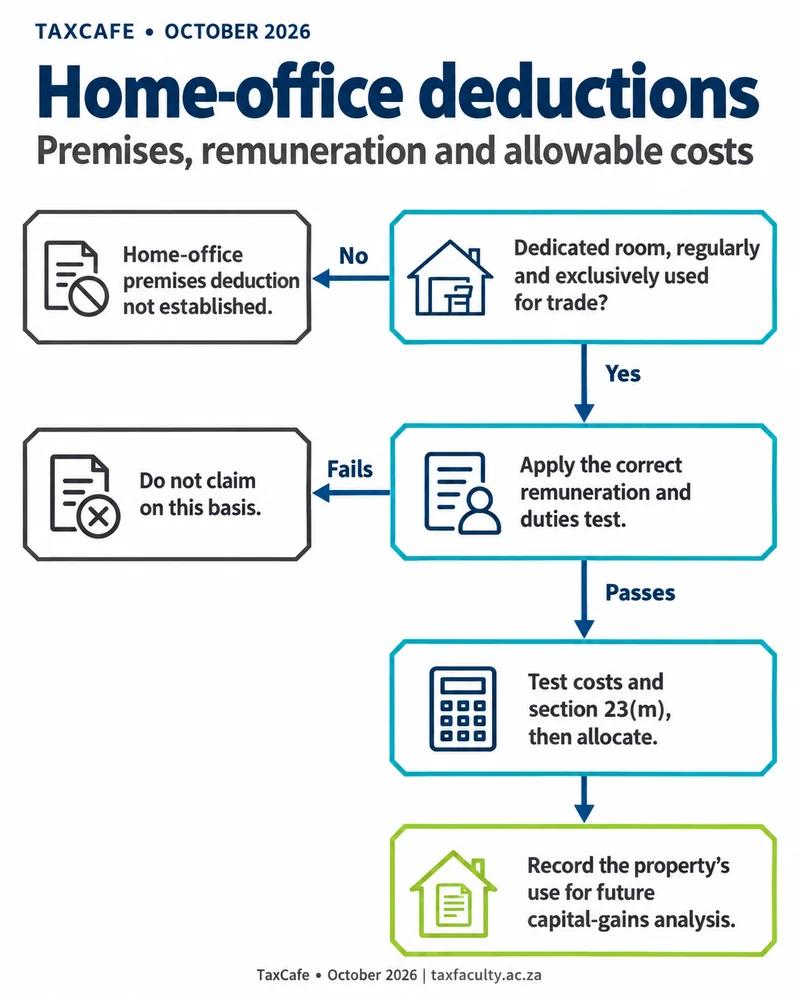
The file should explain why the claim is available, how it was calculated and what future records the client must retain. Where a room has mixed use, the practitioner should address that fact directly rather than relying on a persuasive photograph.
Client conversation trigger: For homeowners claiming home-office expenses, record the start date and floor area and explain the possible effect on a later sale before finalising the claim.
Practitioner action checklist
|
# |
Area |
Issue |
Clients affected |
Action required |
Timing |
|
1 |
Eligibility |
Room and duties tests |
Employees |
Verify remuneration and work pattern |
Annually |
|
2 |
Evidence |
Photos are incomplete proof |
Claimants |
Retain measurements and use evidence |
During year |
|
3 |
Costs |
Incorrect blanket allocation |
Home-office users |
Separate expense categories |
Before claim |
|
4 |
Disposal |
Business-use history |
Homeowners |
Record area and period |
From first use |
Retain evidence of the room’s actual use, the employee’s qualifying work pattern and the cost allocation for each year claimed. Homeowners should carry the use history forward into the eventual disposal calculation.
Related reading: Substantiating business travel by motorcycle; Claiming medical tax credits for disability and care costs; Accounting for cash and benefits earned by content creators.
Frequently asked questions
Can a commission earner claim home office expenses?
Where more than 50% of remuneration is qualifying commission or variable pay, the duties must be performed mainly otherwise than in an office provided by the employer. The room must still be specifically equipped and regularly and exclusively used for trade.
Can I claim a home office in a shared dining room?
No. A different duties test does not turn a shared dining room into a deductible home office, because the exclusive-use condition remains.
Are photographs enough to prove a home office claim?
Photographs help, but cannot establish a whole year’s use. Keep floor measurements, work-pattern evidence, employer confirmation where appropriate, invoices and the expense calculation.
Build your expertise: to apply these principles in practice, explore The Tax Faculty’s Professional Certificate in Taxation of Individuals.
About the author
Dr Stiaan Klue is Executive Dean and CEO of The Tax Faculty. He was the founding CEO of the South African Institute of Taxation (SAIT) and is the founding author of Silke on Tax Administration (LexisNexis).