




CATEGORIES
- (3)AI & Technology
- (52)Accounting & Financial Reporting
- (1)Accounting for Income Tax
- (1)Assessed losses
- (38)Blogs
- (4)Business Advisory
- (8)Capital Gains Tax
- (1)Capital Gains Tax - Individuals Tax
- (1)Capital Gains Tax Implications of Trusts
- (2)Case study: Home office expense
- (1)Case study: Travel allowances
- (1)Company Formations
- (10)Compliance
- (141)Corporate Tax
- (15)Customs and Excise
- (2)Deceased Estate
- (1)Deductions Pre-trade and prepaid expenses
- (1)Deregistration
- (2)Employer and Employee (PAYE and UIF Specific)
- (1)Estate Duty
- (1)Events / Webinars
- (11)Faculty News
- (2)Farming
- (177)Individuals Tax
- (1)Input - Customs Duty
- (3)Interest
- (23)International Tax
- (1)Nature of the rights of beneficiaries
- (1)Notional input tax
- (10)Payroll
- (1)People & Practice Management
- (2)Practical Payroll
- (1)Professional Ethics
- (2)Provisional tax (Link with other Taxes)
- (4)SARS Issues
- (178)Tax Administration
- (2)Tax Administration Part 2B: Resolving Problems with SARS using the Tax Ombud
- (1)Tax Administration Part 3B Dispute Resolution - Objection and appeal
- (8)Tax Dispute Resolution
- (1)Tax Opinions
- (3)Tax Update
- (1)Tax implications of loans to trusts
- (1)Tax residence
- (1)Tax returns and payments
- (3)Transfer-Pricing
- (1)Trust Income / Gain Allocations
- (1)Trust types and income allocations
- (12)Trusts
- (88)VAT
- (3)VAT periods
- (1)Wear and tear allowances
- (14)Wills, Estates & Succession
- (1)Zero Rated
- (2)eFiling
- Show All

Claiming medical tax credits for disability and care costs
- 28 October 2026
- Individuals Tax
- Dr Stiaan Klue
Source: TaxCafe, Carmen Westermeyer CA(SA), October 2026. Available on Webinar-on-Demand: TaxCafe with Carmen Westermeyer - October 2026
At a glance
|
Enquiry |
Rule to apply |
Evidence |
|
Disability |
Statutory functional criteria |
Completed ITR-DD |
|
Person affected |
Taxpayer, spouse or child differs from another dependant |
Relationship and dependency |
|
Expense |
Qualifying, paid and not recoverable |
Itemised invoices and payment |
|
Care facility |
Accommodation is not automatically medical expenditure |
Breakdown and prescribed-list analysis |
|
Certificate |
Permanent: generally 10 years; temporary: 1 year |
Validity period and continuing criteria |
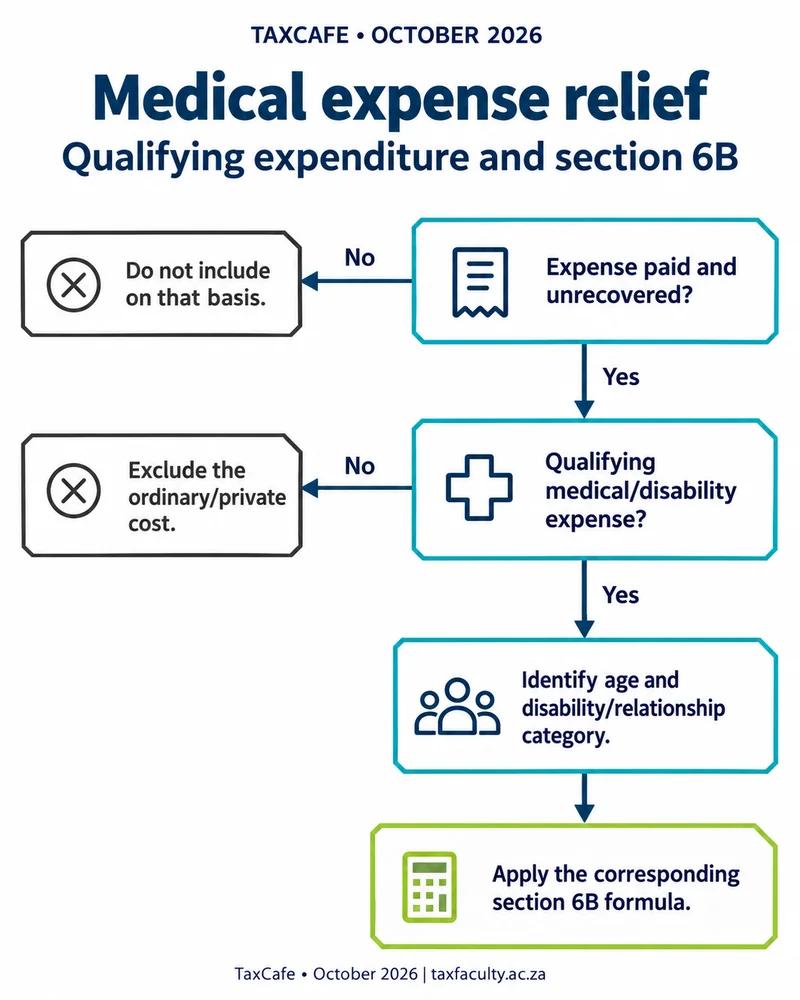
An invoice from a care facility may contain accommodation, meals, nursing, therapy and additional support. The fact that the resident needs care does not make the whole invoice a qualifying medical expense. The practitioner must identify what was supplied, why it was necessary and which statutory category applies.
For families funding care, the credit depends on the nature of the expense, the claimant’s category and the prescribed confirmation of disability where required. The statutory disability test concerns function and daily activities. It should not be reduced to inability to work or a requirement that every condition be permanent.
Establish disability and the claimant category
Section 6B of the Income Tax Act 58 of 1962 governs the additional medical expenses tax credit. Its disability definition concerns a moderate to severe limitation of the ability to function or perform daily activities, meeting the duration and diagnostic criteria. The confirmation of diagnosis of disability form (ITR-DD) is the prescribed confirmation mechanism. A diagnosis alone should not be assumed to establish every part of the tax test.
The South African Revenue Service (SARS) requires completion by a duly registered medical practitioner trained to diagnose the relevant disability or express an opinion on it. That is not a universal requirement for a specialist in every case. The current guidance provides generally for ten-year validity for a permanent disability and one year for a temporary disability, with the applicable form conditions and continuing qualification to be checked. Retain the form and provide it when requested. SARS: tax and disability.
The credit calculation also depends on the claimant’s category. A qualifying disability of the taxpayer, spouse or child attracts the relevant 33.3% treatment. A disabled parent or sibling does not automatically put a younger taxpayer into that category. The separate treatment for taxpayers aged 65 or older must also be considered. SARS: additional medical expenses tax credit.
Client conversation trigger: Review care-funding clients’ age, relationship to the patient and ITR-DD validity before selecting the calculation category.
Unpack the facility invoice
Obtain an itemised statement identifying the patient, service provider, period, services and amounts. Establish who paid and whether any part was reimbursed or recoverable from a medical scheme or another source. A facility invoice in the patient’s name does not by itself prove payment by the taxpayer claiming the credit.
For expenditure incurred in consequence of a physical impairment or disability, check the prescribed list and its limitations. The enquiry is whether the particular expense qualifies, not whether the facility markets itself as assisted living or frail care. Ordinary living costs should not be included merely because they appear on the same invoice as qualifying treatment. Equally, qualifying disability-related expenditure should not be rejected solely because it falls outside a conventional consultation fee. SARS: Guide on the Determination of Medical Tax Credits, Issue 18.
Prepare a schedule with a separate conclusion for each cost category. Where the facility cannot distinguish its charges, request the basis on which the composite fee is calculated. A supported allocation is preferable to an unsupported percentage selected at year-end.
Client conversation trigger: Ask families paying composite care fees to obtain an annual service breakdown and retain the proof of payment before the facility’s records become difficult to retrieve.
Calculate the additional medical expenses tax credit
For the qualifying disability category, the calculation includes 33.3% of qualifying unrecovered out-of-pocket expenses, plus 33.3% of medical-scheme contributions exceeding three times the medical scheme fees tax credit, as applicable. These are tax-credit calculations; the qualifying expense is not simply deducted from taxable income.
Illustrative example. A taxpayer whose spouse has a qualifying disability pays R60 000 of qualifying, unrecovered out-of-pocket expenses during the year. Assume no medical-scheme contributions and sufficient normal tax against which to apply the credit. The additional medical expenses tax credit from those expenses is R60 000 × 33.3% = R19 980. It is not R20 000 obtained by rounding the statutory percentage to one third, and it is not a R60 000 deduction from income.
The calculation should be checked against the medical-scheme certificate and expenses already taken into account. Double counting an invoice paid partly by the scheme can overstate the credit even when the underlying service qualifies.
Client conversation trigger: Give clients a calculation showing the qualifying amount, recoveries, applicable category and resulting credit so that the expected tax benefit is understood before filing.
Practitioner action checklist
|
# |
Area |
Issue |
Clients affected |
Action required |
Timing |
|
1 |
Diagnosis |
Functional criteria |
Disability claimants |
Obtain valid ITR-DD |
Before claim |
|
2 |
Category |
Age and relationship |
Care-funding families |
Select correct section 6B formula |
Annually |
|
3 |
Costs |
Composite facility invoice |
Facility residents |
Itemise and test each charge |
During year |
|
4 |
Payment |
Recoveries and duplication |
All claimants |
Reconcile invoices and payments |
Before filing |
Give the client a calculation that identifies qualifying expenditure, recoveries and the resulting credit. Retain the itemised invoices and any required disability confirmation with it.
Related reading: Establishing a home office deduction for commission earners; Resolving retirement directives and missing transfer records; Responding to verification requests and identifying audit.
Frequently asked questions
Is the whole care facility invoice a qualifying medical expense?
No. An invoice may contain accommodation, meals, nursing, therapy and support. The practitioner must identify what was supplied, why it was necessary and which statutory category applies.
What counts as a disability for the additional medical expenses tax credit?
Section 6B concerns a moderate to severe limitation of the ability to function or perform daily activities, meeting the duration and diagnostic criteria. It should not be reduced to inability to work.
Who must complete the ITR-DD disability form?
A duly registered medical practitioner trained to diagnose the relevant disability or express an opinion on it. That is not a universal requirement for a specialist in every case.
Build your expertise: to apply these principles in practice, explore The Tax Faculty’s Short Course in Personal Income Tax.
About the author
Dr Stiaan Klue is Executive Dean and CEO of The Tax Faculty. He was the founding CEO of the South African Institute of Taxation (SAIT) and is the founding author of Silke on Tax Administration (LexisNexis).