




CATEGORIES
- (3)AI & Technology
- (52)Accounting & Financial Reporting
- (1)Accounting for Income Tax
- (1)Assessed losses
- (38)Blogs
- (4)Business Advisory
- (8)Capital Gains Tax
- (1)Capital Gains Tax - Individuals Tax
- (1)Capital Gains Tax Implications of Trusts
- (2)Case study: Home office expense
- (1)Case study: Travel allowances
- (1)Company Formations
- (10)Compliance
- (141)Corporate Tax
- (15)Customs and Excise
- (2)Deceased Estate
- (1)Deductions Pre-trade and prepaid expenses
- (1)Deregistration
- (2)Employer and Employee (PAYE and UIF Specific)
- (1)Estate Duty
- (1)Events / Webinars
- (11)Faculty News
- (2)Farming
- (177)Individuals Tax
- (1)Input - Customs Duty
- (3)Interest
- (23)International Tax
- (1)Nature of the rights of beneficiaries
- (1)Notional input tax
- (10)Payroll
- (1)People & Practice Management
- (2)Practical Payroll
- (1)Professional Ethics
- (2)Provisional tax (Link with other Taxes)
- (4)SARS Issues
- (178)Tax Administration
- (2)Tax Administration Part 2B: Resolving Problems with SARS using the Tax Ombud
- (1)Tax Administration Part 3B Dispute Resolution - Objection and appeal
- (8)Tax Dispute Resolution
- (1)Tax Opinions
- (3)Tax Update
- (1)Tax implications of loans to trusts
- (1)Tax residence
- (1)Tax returns and payments
- (3)Transfer-Pricing
- (1)Trust Income / Gain Allocations
- (1)Trust types and income allocations
- (12)Trusts
- (88)VAT
- (3)VAT periods
- (1)Wear and tear allowances
- (14)Wills, Estates & Succession
- (1)Zero Rated
- (2)eFiling
- Show All

Auto-assessments: who actually has until 22 January 2027?
- 27 October 2026
- Individuals Tax
- Dr Stiaan Klue
Source: Monthly Tax Update, Professor Jackie Arendse, October 2026. Webinar-on-Demand: Monthly SARS Update with Prof Jackie Arendse - October 2026
At a glance
|
Route |
Scope |
Date or period |
|
Notice 7958 |
Qualifying provisional taxpayer; specified automatic assessment issued on or before 24 November 2026 |
22 January 2027 |
|
Notice 7602 |
Taxpayer within the specified automatic-assessment class; assessment dated on or before 27 August 2026 |
23 October 2026, already elapsed at this article’s preparation date |
|
Ordinary section 95(6) rule |
Relevant estimated assessment where no applicable longer period governs |
40 business days from assessment |
|
Individual extension |
Reasonable grounds submitted under section 95(7), subject to the statutory limits and decision |
Case-specific; not automatic |
The extension to 22 January 2027 is useful, but it is not a general reprieve for every auto-assessed individual. Notice 7958 expressly limits its scope to provisional taxpayers meeting the specified conditions. A practice that applies the January date to its entire individual-tax client list risks missing deadlines for clients outside that class.
The first task is therefore classification, not merely changing a calendar entry. The accountant must identify the taxpayer’s statutory status, the type and date of assessment and the public notice or ordinary rule governing the response.
Read the two notices together
Notice 7958, published in Government Gazette 55438 on 25 September 2026, extends the date for requesting a reduced or additional assessment to 22 January 2027. It applies to a provisional taxpayer as defined in paragraph 1 of the Fourth Schedule who received the specified automatic assessment under paragraph 3(3) of Notice 7422. The automatic assessment must have been issued on or before 24 November 2026.
Notice 7602, published on 19 June 2026, provided the earlier extension to 23 October 2026 for the specified auto-assessment class. It excluded automatic assessments dated after 27 August 2026. As at 27 October 2026, that October deadline has passed. A client who falls outside the January extension needs an immediate review of the ordinary period and any available extension route, rather than an assumption that the later date applies.
Provisional-tax status is a legal classification. A client’s historic submission of an IRP6, or the accountant’s use of a “provisional” folder, is not a substitute for applying the definition and exclusions. Record the reason for the classification in the file and retain the assessment showing its issue date.
Client conversation trigger: Split the auto-assessed client list by provisional-tax status and assessment date, and identify every client whose correction deadline may already have passed.
The correction request must contain the correct information
Section 95(6) provides for a request for a reduced or additional assessment by submitting a true and full return or relevant material within the applicable period. The ordinary period is 40 business days from assessment, unless a longer period prescribed by public notice applies. This is a substantive correction process, not merely an expression of disagreement.
Compare the assessment with the client’s complete facts. Third-party data may accurately report one source while omitting another, and a prepopulated deduction may still require substantiation. Reconcile employment certificates, investment income, business or rental activity, disposals, medical information and claimed deductions as relevant to that client. The list is an editorial review framework, not an assumption that every category applies to every auto-assessed person.
The process can result in additional tax as well as a reduction. A full review should therefore address omitted taxable amounts, not only potential refunds. Retain the submitted return, schedules and acknowledgement so that the practice can prove what was filed and when.
Client conversation trigger: Ask each affected client to confirm all income sources and material disposals before treating the auto-assessment as complete or submitting a correction limited to deductions.
Missing the date does not justify inventing another deadline
Section 95(7) permits a senior South African Revenue Service (SARS) official to extend the period where reasonable grounds are submitted, subject to the statutory limit. The application should explain the actual reasons, chronology, outstanding information and steps taken. The existence of the power does not establish that an extension has been granted.
Do not add a fresh 40-business-day period after 22 January 2027 merely because section 95 ordinarily uses that period. Equally, an assessment outside a notice’s cut-off is not automatically subject to the notice’s deadline. It must be placed in the appropriate statutory route and calculated from the relevant event.
The objection sequence also needs attention. Section 95 contains a specific mechanism for estimates and correction requests, including consequences where SARS declines to make the requested assessment. A disagreement with an auto-assessment should not automatically be converted into an ordinary objection without considering that mechanism. If the response is adverse, preserve the written decision and calculate the next procedural period from the legally relevant event.
Client conversation trigger: For a late or rejected correction, prepare a dated procedural memorandum identifying the section 95 route, extension request and written SARS decision before lodging the next step.
Correction and payment require separate decisions
The tax account may show an amount payable while a correction is being pursued. The 2026 amendment to section 164 expressly allows a taxpayer who intends to request, or requests, a reduced assessment under section 95(6) to request suspension of payment. The senior official’s discretion depends on the statutory factors; the correction request itself is not an automatic grant of suspension.
A payment review should therefore run alongside the correction file. Record the due date, amount, intended reduction, cash-flow implications and any suspension request. Where suspension is sought, address the relevant evidence rather than relying on a general statement that the assessment is wrong.
An editorial example illustrates the classification exercise. Client A is a qualifying provisional taxpayer with an automatic assessment issued on 20 November 2026: Notice 7958 supplies the 22 January 2027 date. Client B is not a provisional taxpayer and received an automatic assessment on 20 August 2026: the January notice does not assist B; the October notice and any subsequent extension position require review. These examples assume the assessments fall within the notices’ specified automatic-assessment category.
Client conversation trigger: Where a disputed auto-assessment creates a payment obligation, assess a section 164 request at the same time as the section 95 correction rather than leaving collection to follow its own course.
A deadline decision path
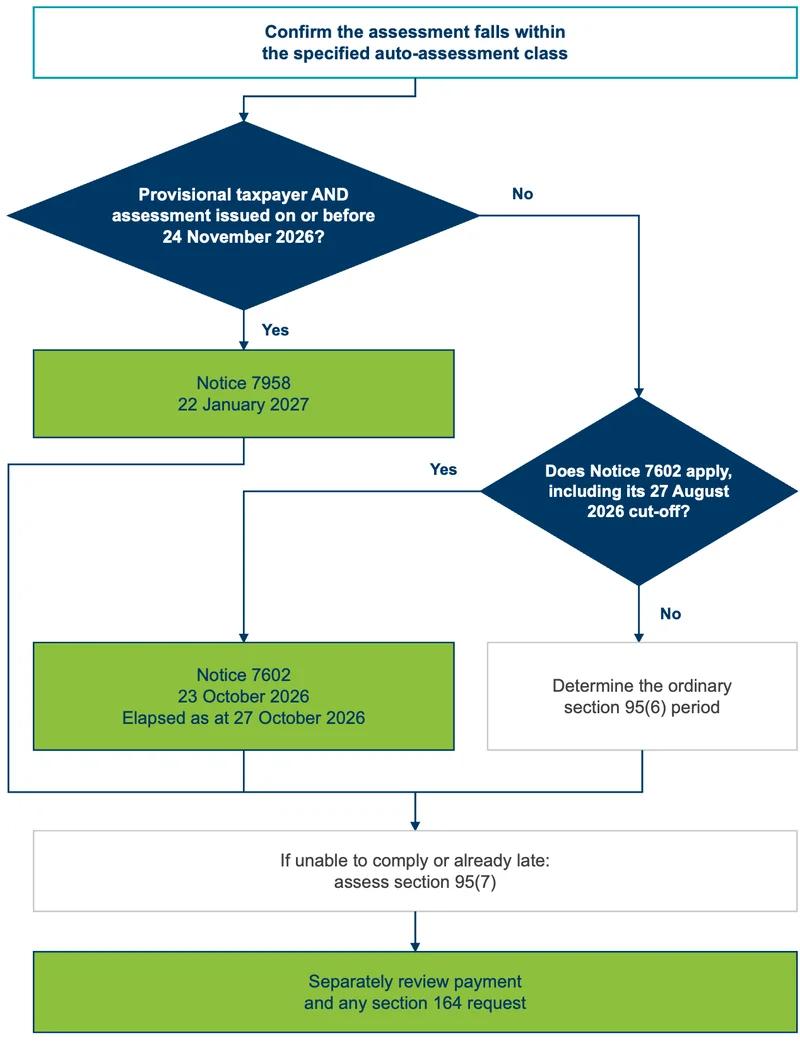
Practitioner action checklist
|
# |
Area |
Finding or requirement |
Clients affected |
Action required |
Deadline |
|
1 |
Classification |
January relief is restricted. |
Auto-assessed individuals |
Verify provisional status, assessment class and date. |
Immediately |
|
2 |
January cases |
Notice 7958 applies only within its cut-off. |
Qualifying provisional taxpayers |
Complete and submit the true and full correction. |
22 January 2027 |
|
3 |
October cases |
Notice 7602’s deadline has elapsed. |
Clients relying on that notice |
Review late-correction and extension position. |
Immediately |
|
4 |
Other cases |
Ordinary or individually extended periods may govern. |
Clients outside notice scope |
Calculate and document the applicable period. |
Case-specific |
|
5 |
Payment |
Suspension requires separate consideration. |
Clients with amounts payable |
Assess and support any section 164 request. |
Before collection risk becomes acute |
Related reading: Estimated assessments: challenge the calculation and prove the alternative; Voluntary disclosure: eligibility, voluntariness and relief are different questions; Protecting dispute deadlines while pursuing SARS complaints.
Official source: Tax Administration Act 28 of 2011 (South African Government).
Frequently asked questions
Who has until 22 January 2027 to correct an auto-assessment?
Notice 7958 extends the date to 22 January 2027 for a provisional taxpayer, as defined in the Fourth Schedule, who received the specified automatic assessment. That assessment must have been issued on or before 24 November 2026.
Is the 23 October 2026 auto-assessment deadline still open?
No. Notice 7602 gave the earlier extension to 23 October 2026, and that date has passed. A client outside the January extension needs an immediate review of the ordinary period and any available extension route.
How long do I have to request a reduced or additional assessment?
Under section 95(6) of the Tax Administration Act, the ordinary period is 40 business days from the assessment, unless a longer period prescribed by public notice applies. The request requires a true and full return or relevant material.
Does correcting an auto-assessment stop SARS collecting the tax?
Not automatically. Correction and payment are separate decisions, so a section 164 request for suspension of payment should be assessed at the same time as the section 95 correction.
Build your expertise: to apply these principles in practice, explore The Tax Faculty’s Microlearning Course: Completing the ITR12.
About the author
Dr Stiaan Klue is Executive Dean and CEO of The Tax Faculty. He was the founding CEO of the South African Institute of Taxation (SAIT) and is the founding author of Silke on Tax Administration (LexisNexis).