




CATEGORIES
- (3)AI & Technology
- (52)Accounting & Financial Reporting
- (1)Accounting for Income Tax
- (1)Assessed losses
- (38)Blogs
- (4)Business Advisory
- (8)Capital Gains Tax
- (1)Capital Gains Tax - Individuals Tax
- (1)Capital Gains Tax Implications of Trusts
- (2)Case study: Home office expense
- (1)Case study: Travel allowances
- (1)Company Formations
- (10)Compliance
- (141)Corporate Tax
- (15)Customs and Excise
- (2)Deceased Estate
- (1)Deductions Pre-trade and prepaid expenses
- (1)Deregistration
- (2)Employer and Employee (PAYE and UIF Specific)
- (1)Estate Duty
- (1)Events / Webinars
- (11)Faculty News
- (2)Farming
- (177)Individuals Tax
- (1)Input - Customs Duty
- (3)Interest
- (23)International Tax
- (1)Nature of the rights of beneficiaries
- (1)Notional input tax
- (10)Payroll
- (1)People & Practice Management
- (2)Practical Payroll
- (1)Professional Ethics
- (2)Provisional tax (Link with other Taxes)
- (4)SARS Issues
- (178)Tax Administration
- (2)Tax Administration Part 2B: Resolving Problems with SARS using the Tax Ombud
- (1)Tax Administration Part 3B Dispute Resolution - Objection and appeal
- (8)Tax Dispute Resolution
- (1)Tax Opinions
- (3)Tax Update
- (1)Tax implications of loans to trusts
- (1)Tax residence
- (1)Tax returns and payments
- (3)Transfer-Pricing
- (1)Trust Income / Gain Allocations
- (1)Trust types and income allocations
- (12)Trusts
- (88)VAT
- (3)VAT periods
- (1)Wear and tear allowances
- (14)Wills, Estates & Succession
- (1)Zero Rated
- (2)eFiling
- Show All

Reconstructing liability after backdated VAT registration
- 28 October 2026
- VAT
- Dr Stiaan Klue
Source: TaxCafe, Carmen Westermeyer CA(SA), October 2026. Available on Webinar-on-Demand: TaxCafe with Carmen Westermeyer - October 2026
At a glance
|
Period or issue |
Relevant position |
Required response |
|
Before 1 April 2026 |
R1 million compulsory-registration threshold |
Test historical liability |
|
From 1 April 2026 |
SARS administers R2.3 million compulsory and R120 000 voluntary thresholds |
Read the legislative-status qualification |
|
Current turnover below threshold |
Does not erase an earlier obligation |
Separate historic liability from cancellation |
|
Pre-registration expenditure |
No blanket deduction for all assets |
Test documentary, use and adjustment rules |
|
Disputed registration |
Nil returns do not resolve the dispute |
Protect the correct statutory remedy |
A business receiving a backdated VAT registration notice may have current taxable supplies below R2.3 million and still have incurred a historical registration obligation. The relevant threshold is the one applicable when the liability arose. A current turnover figure cannot answer that historical question.
Reconstruct taxable supplies for each relevant period, establish the effective registration date and test the available input claims. If the position is disputed, preserve the appropriate remedy while preparing accurate returns. Payment difficulties require a separate response after the liability has been established.
Test the effective date against the correct threshold
Section 23 of the Value-Added Tax Act 89 of 1991 governs registration. Analyse taxable supplies over the applicable consecutive 12-month period and any relevant forward-looking test. Use taxable supplies rather than an undifferentiated accounting-turnover figure. Exempt supplies, capital transactions and the statutory exceptions require their own treatment.
The South African Revenue Service (SARS) states that it is administering new applications using the increased thresholds from 1 April 2026. Its Budget 2026 FAQ expressly qualifies that administrative position by reference to amendments not yet promulgated and Parliament’s legislative process. That qualification must accompany advice based on the new thresholds; an announcement should not be described as an enacted amendment without verification. SARS: Budget 2026 VAT FAQs.
|
Threshold |
Earlier amount |
Amount administered from 1 April 2026 |
|
Compulsory registration |
R1 000 000 |
R2 300 000 |
|
General voluntary threshold |
R50 000 |
R120 000 |
The administrative threshold change in 2026 does not retrospectively erase liability under the earlier threshold. Nor does an existing vendor simply stop accounting for VAT because supplies are now below the compulsory threshold. Cancellation requires its own process and effective date, with possible final-period adjustments.
Illustrative comparison. A business exceeds R1 million of relevant taxable supplies in a qualifying period during 2025. Its supplies later stabilise at R1.5 million. The later figure may support consideration of cancellation under the new administrative position, but it does not by itself negate the earlier registration liability. Exact dates, the statutory tests and any exceptions still need to be established.
Client conversation trigger: For every backdating notice, prepare a monthly taxable-supplies schedule spanning the alleged commencement date and the April 2026 transition.
Reconstruct output tax and examine each input claim
Once the effective date is established, determine the time and value of supplies for each period. Contracts may have fixed a VAT-inclusive price or permitted VAT to be added. That affects the commercial recovery from customers, not necessarily the statutory liability to SARS.
Illustrative example. Assume R1 150 000 of standard-rated consideration is VAT-inclusive and subject to a 15% rate. The output-tax component is R1 150 000 × 15/115 = R150 000. This is not the same as adding 15% to the amount already agreed. The example ignores input tax, timing adjustments, penalties and interest so that the pricing distinction remains clear.
Input tax requires separate substantiation under sections 16 and 17 of the Value-Added Tax Act. Obtain the prescribed documents and establish the taxable-use connection. Excluded expenditure does not become deductible because registration was backdated. The relevant period, possession of documents, time limits and any apportionment must be considered.
Assets acquired before the effective registration date require particular care. Section 18(4) can provide a change-in-use adjustment in qualifying circumstances, using its statutory valuation and use rules. It is not a general entitlement to claim VAT on “all assets” at original cost. Second-hand goods, motor cars, entertainment and mixed-use assets can raise additional restrictions or conditions. SARS: VAT 404 Guide for Vendors, chapters on input tax and adjustments.
Client conversation trigger: Build an asset-by-asset and invoice-by-invoice input schedule, distinguishing ordinary input deductions from any registration-related change-in-use adjustment.
Read the notice before choosing the response
A VAT217 or other calculation document must be read for what it actually records. Identify whether it is a simulation, proposed adjustment, assessment or another communication, and reconcile its periods, taxable supplies, output tax, input tax, penalties and interest. A simulated figure should not be treated as a final assessment merely because it looks official; an actual assessment should not be dismissed as a simulation.
If the registration or effective date is disputed, obtain the reasons and identify the available objection or other review route. Section 32 of the Value-Added Tax Act and the Tax Administration Act 28 of 2011 must be applied to the particular decision. A complaint about service is not a substitute for challenging a tax decision within time.
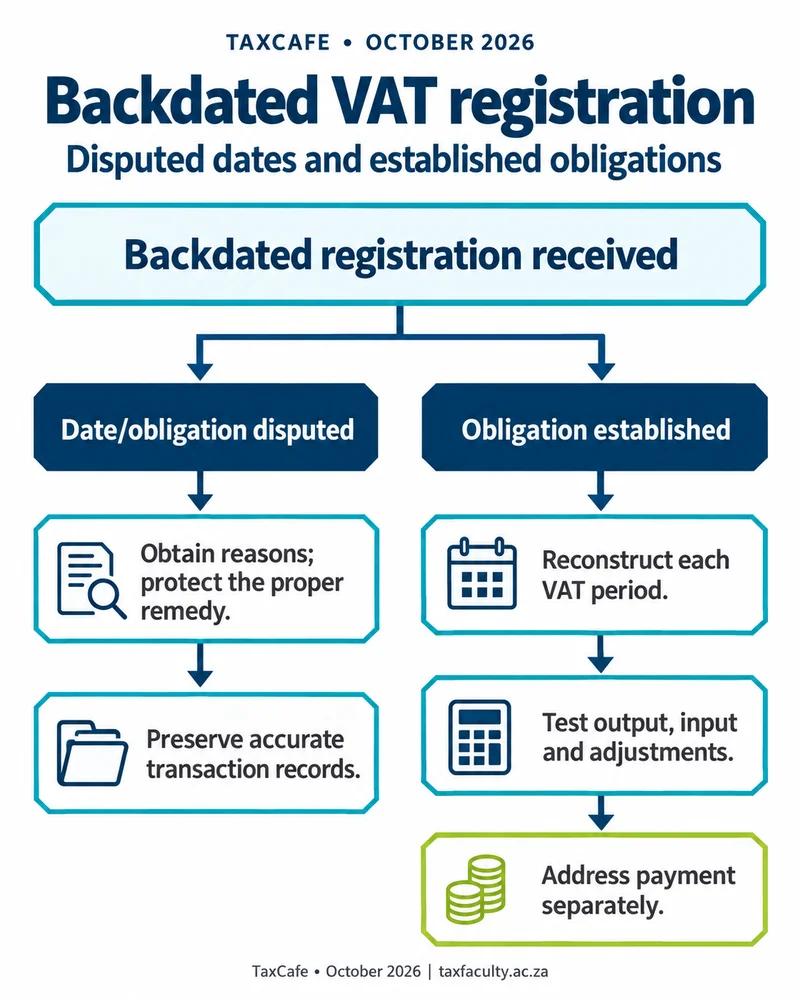
Do not file nil returns that misstate known transactions simply to clear outstanding periods. Establish the compliant submission approach while the dispute is pursued. If the debt is correct but payment is unaffordable, consider a supported instalment or compromise application under the Tax Administration Act. Financial hardship does not, by itself, make a valid registration unlawful or establish entitlement to a compromise.
Client conversation trigger: Separate the client's objection to liability from the cash-flow problem and agree a documented plan for returns, dispute deadlines and payment relief.
Practitioner action checklist
|
# |
Area |
Issue |
Clients affected |
Action required |
Timing |
|
1 |
Registration |
Historical threshold and date |
Backdated vendors |
Reconstruct rolling supplies |
On notice |
|
2 |
Calculation |
Inclusive pricing and periods |
Unregistered businesses |
Rebuild output-tax schedule |
Before returns |
|
3 |
Input |
Documents and asset adjustments |
Newly registered vendors |
Test each deduction separately |
Before claim |
|
4 |
Remedy |
Decision versus simulation |
Disputed notices |
Identify legal status and deadline |
Immediately |
|
5 |
Payment |
Affordability |
Correct but unpaid debts |
Prepare evidence for relief |
Before enforcement |
The completed file should explain the effective date, each period’s output and input tax, and the basis of any challenge. Agree a payment response separately so that affordability does not distort the returns.
Related reading: VAT modernisation: prepare the transaction data before buying the technology; Completing the diesel refund registration transition; Accounting for cash and benefits earned by content creators.
Frequently asked questions
Can SARS backdate VAT registration if my turnover is now below R2.3 million?
Yes, potentially. The relevant threshold is the one applicable when the liability arose, so current turnover cannot answer that historical question.
What turnover counts towards the VAT registration threshold?
Section 23 of the VAT Act looks at taxable supplies over the applicable 12-month period, not an undifferentiated accounting-turnover figure. Exempt supplies, capital transactions and statutory exceptions need their own treatment.
What if I cannot afford the backdated VAT?
Payment difficulties require a separate response after the liability has been established, so affordability does not distort the returns.
Build your expertise: to apply these principles in practice, explore The Tax Faculty’s Short Course in Value-Added Tax.
About the author
Dr Stiaan Klue is Executive Dean and CEO of The Tax Faculty. He was the founding CEO of the South African Institute of Taxation (SAIT) and is the founding author of Silke on Tax Administration (LexisNexis).