




CATEGORIES
- (3)AI & Technology
- (52)Accounting & Financial Reporting
- (1)Accounting for Income Tax
- (1)Assessed losses
- (38)Blogs
- (4)Business Advisory
- (8)Capital Gains Tax
- (1)Capital Gains Tax - Individuals Tax
- (1)Capital Gains Tax Implications of Trusts
- (2)Case study: Home office expense
- (1)Case study: Travel allowances
- (1)Company Formations
- (10)Compliance
- (141)Corporate Tax
- (15)Customs and Excise
- (2)Deceased Estate
- (1)Deductions Pre-trade and prepaid expenses
- (1)Deregistration
- (2)Employer and Employee (PAYE and UIF Specific)
- (1)Estate Duty
- (1)Events / Webinars
- (11)Faculty News
- (2)Farming
- (177)Individuals Tax
- (1)Input - Customs Duty
- (3)Interest
- (23)International Tax
- (1)Nature of the rights of beneficiaries
- (1)Notional input tax
- (10)Payroll
- (1)People & Practice Management
- (2)Practical Payroll
- (1)Professional Ethics
- (2)Provisional tax (Link with other Taxes)
- (4)SARS Issues
- (178)Tax Administration
- (2)Tax Administration Part 2B: Resolving Problems with SARS using the Tax Ombud
- (1)Tax Administration Part 3B Dispute Resolution - Objection and appeal
- (8)Tax Dispute Resolution
- (1)Tax Opinions
- (3)Tax Update
- (1)Tax implications of loans to trusts
- (1)Tax residence
- (1)Tax returns and payments
- (3)Transfer-Pricing
- (1)Trust Income / Gain Allocations
- (1)Trust types and income allocations
- (12)Trusts
- (88)VAT
- (3)VAT periods
- (1)Wear and tear allowances
- (14)Wills, Estates & Succession
- (1)Zero Rated
- (2)eFiling
- Show All

Completing a passive trust return without omitting its affairs
- 28 October 2026
- Compliance
- Dr Stiaan Klue
Source: TaxCafe, Carmen Westermeyer CA(SA), October 2026. Available on Webinar-on-Demand: TaxCafe with Carmen Westermeyer - October 2026
At a glance
|
Label or fact |
What it establishes |
What it does not establish |
|
Passive trust |
A return classification based on the relevant facts |
Exemption from filing |
|
Asset-holding trust |
The trust owns assets |
Absence of liabilities or reportable information |
|
No rent received |
No rental receipt identified |
No accrual, funding or other activity |
|
No tax payable |
A possible calculation outcome |
Permission to omit the balance sheet |
A trust that owns a family holiday home may have no rental receipts and still have assets, expenditure, funding arrangements and beneficiaries whose details must be disclosed. Describing it as dormant can conceal the very information needed to prepare its return properly.
The South African Revenue Service (SARS) provides a shortened income-tax return for trusts (ITR12T) that qualify as passive. Its current guide still asks whether the trust holds assets and how it was financed. Practitioners should establish those facts before selecting the classification and complete every section that the correct answers require. SARS: comprehensive trust return guide.
Establish annual transactions before choosing the label
Start with the bank statements, investment statements, asset register and loan accounts. A trust may have incurred interest, received a donation, acquired an asset or settled expenditure through a trustee’s personal account without operating its own bank account. Absence of bank movements in the trust’s name is therefore not conclusive.
The working papers should distinguish the trust’s legal existence from its economic activity in a particular year. Trustees’ duties under the Trust Property Control Act 57 of 1988 continue while the trust exists. The annual return obligation under the Tax Administration Act 28 of 2011 and the applicable filing notice must also be considered independently of the amount of taxable income.
The passive classification should follow the current ITR12T questions and the actual activity. It should not be selected merely because it produces fewer fields. If answering the questions accurately opens additional sections, complete them. Retain the records supporting those answers with the completed return.
Client conversation trigger: Ask trustees who describe a trust as dormant to confirm every asset, liability and transaction during the year, including amounts settled outside the trust’s bank account.
Explain how the assets are funded and used
An asset-holding trust ordinarily has a funding history. A property may have been donated, purchased with borrowed money or acquired subject to a beneficiary’s vested rights. The balance sheet should show that history consistently. An unexplained balancing amount labelled “capital” can hide a loan or a donation requiring separate tax treatment.
Where a connected person funds the trust on interest-free or low-interest terms, section 7C of the Income Tax Act 58 of 1962 may require analysis, subject to its conditions and exclusions. The absence of cash interest is a reason to investigate the arrangement, not evidence that nothing happened for tax purposes. The analysis should identify the lender, connection, balance, actual interest and applicable official rate for each relevant period.
Similarly, a property used by a beneficiary may generate no rental income while still producing expenditure and benefits that need to be understood. Maintenance payments by a founder, improvements, municipal charges and insurance should be traced to the person who incurred or funded them. Disclosure does not mean that every expense becomes deductible. Private use and the requirements for deductions remain separate questions.
Illustrative example. A trust holds a property costing R2 million, funded by a R1.9 million founder’s loan and R100 000 of capital. No rent is charged. Reporting only “nil income” omits the asset, the funding and any annual expenditure. Those facts remain relevant even if the eventual normal-tax liability is zero.
Client conversation trigger: For lifestyle-asset trusts, prepare a funding-and-use schedule and review connected-person loans before accepting a zero-tax computation.
Reconcile the annual disclosures and registration status
The annual file should reconcile opening and closing assets and liabilities, explain movements and match the return’s disclosures. Trustee resolutions should support decisions that affect beneficiaries. Beneficial-ownership records and registered particulars should be checked separately from the income calculation.
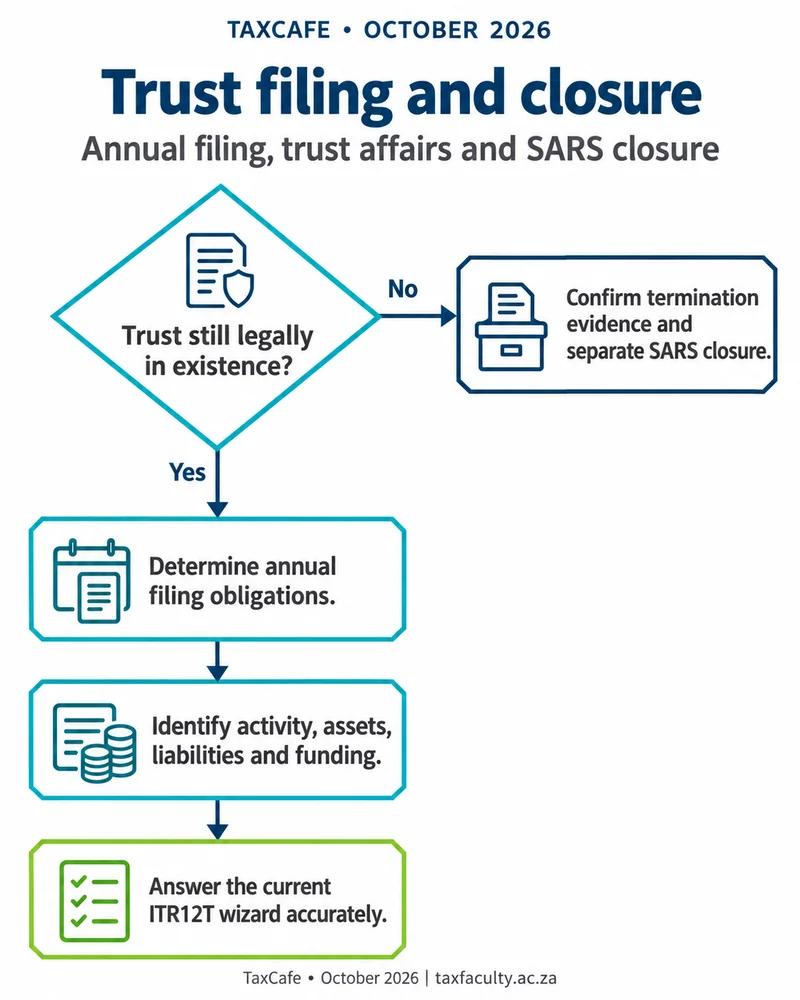
If a trust has been terminated, do not assume that the Master’s process automatically closes its SARS registration. Obtain confirmation of the tax-registration position and resolve outstanding periods. Conversely, keeping an unnecessary trust registered indefinitely creates continuing administration that trustees should address deliberately.
SARS has identified nil returns and assessed-loss positions as a focus in the 2026 trust filing season. A complete record should explain the result without requiring the practitioner to reconstruct the trust’s history in response to a query. SARS: trust filing announcement.
Client conversation trigger: Divide passive-trust clients into those retaining assets and those genuinely ready for termination, then agree a documented compliance or closure plan for each.
Practitioner action checklist
|
# |
Area |
Issue |
Clients affected |
Action required |
Timing |
|
1 |
Classification |
Passive status |
Low-activity trusts |
Establish all annual activity |
Before ITR12T |
|
2 |
Balance sheet |
Assets and funding |
Asset holders |
Reconcile asset and loan registers |
Annually |
|
3 |
Tax analysis |
Funding and private use |
Family trusts |
Review section 7C and deductions |
Before finalisation |
|
4 |
Closure |
Separate registrations |
Terminated trusts |
Obtain Master and SARS evidence |
On termination |
The shortened return should agree with a complete record of the trust’s assets, funding and annual activity. Trustees should resolve any missing information before confirming the return.
Related reading: Establishing when a trust has nothing to report on IT3t; Correcting trust identity records and beneficiary information; Trust migration and CGT: the tax year can end before the cash arrives.
Frequently asked questions
Does a dormant trust still need to submit a tax return?
The annual return obligation under the Tax Administration Act and the filing notice must be considered independently of taxable income. A trust with no rental receipts may still have assets, expenditure, funding and beneficiaries to disclose.
What does the shortened passive trust return ask for?
SARS’s current guide still asks whether the trust holds assets and how it was financed. Establish those facts before selecting the passive classification and complete every section the answers require.
Is a trust with no bank account inactive for tax purposes?
Not necessarily. A trust may incur interest, receive a donation, acquire an asset or have expenditure settled through a trustee’s personal account without operating its own bank account.
Build your expertise: to apply these principles in practice, explore The Tax Faculty’s Short Course in Taxation and Administration of Trusts.
About the author
Dr Stiaan Klue is Executive Dean and CEO of The Tax Faculty. He was the founding CEO of the South African Institute of Taxation (SAIT) and is the founding author of Silke on Tax Administration (LexisNexis).